

Specialized Thermador Appliance Repair in San Francisco
Mon–Sat: 8:00 AM – 7:00 PM
A plain-language guide to the codes a Thermador dishwasher shows, grouped by drain, fill, leak, heat and power problems, with the owner checks that are safe to try.
Thermador repair · San Francisco & the Bay Area
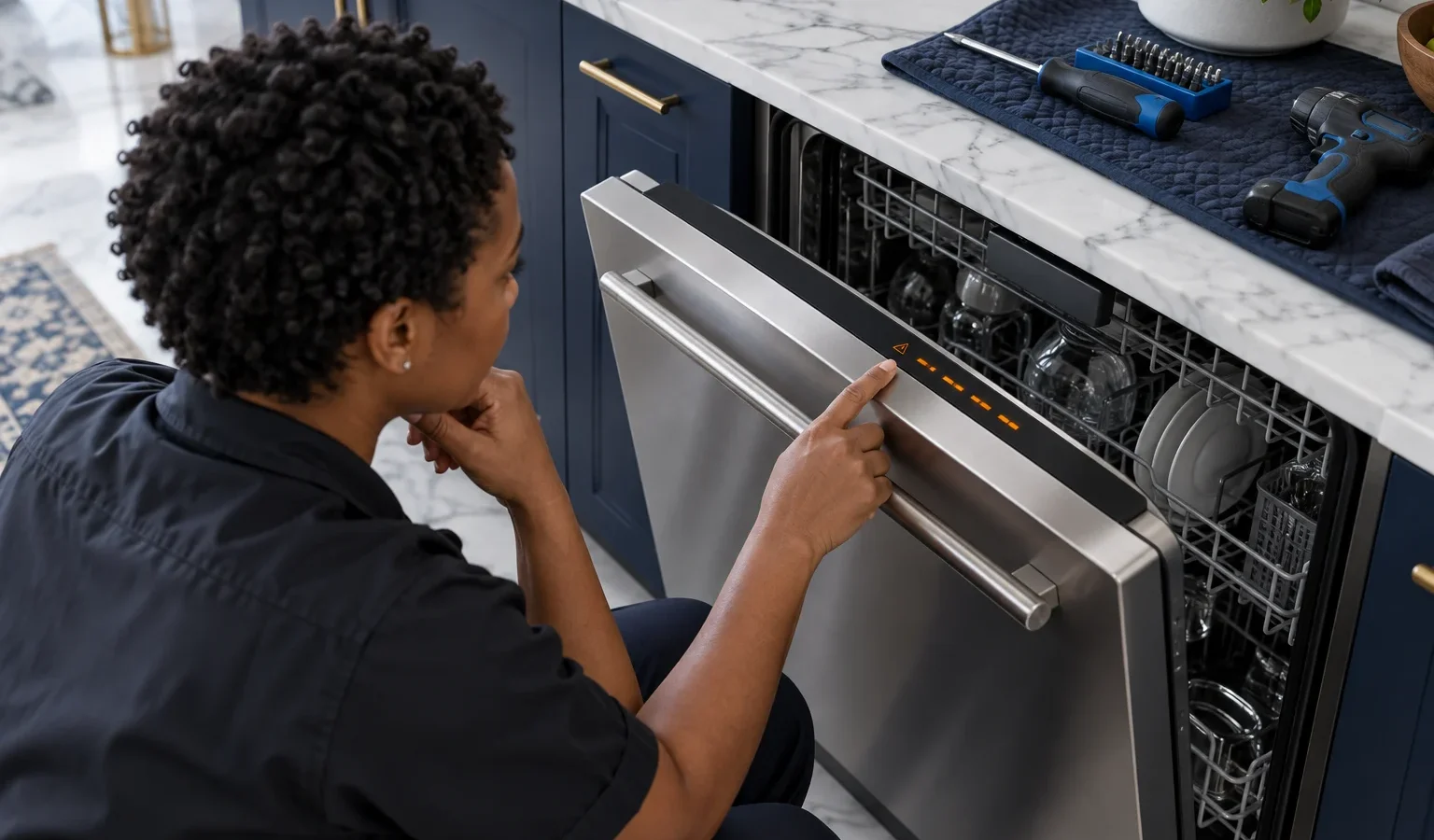
A code on a Thermador dishwasher display is the machine telling you which circuit or water path stopped the cycle. It rarely names the failed part. It names the area, and the area is enough to decide what to check next. Codes also come in two styles: shorter ones such as E22 and four-digit ones such as E6102, and on some units a pair that lights alternately on the display, written like E:61-02.
Write it down exactly, including any dash or colon, and note what the dishwasher was doing when it appeared: filling, washing, draining or drying. Then press the door shut firmly and look at whether the code returns on the next start. A code that appears once after a power flicker means something different from one that returns every cycle. Many San Francisco kitchens with panel-ready dishwashers sit behind a flush door, so make sure that door is fully latched before you judge anything.
The largest family is the drain group. E22, E24, E25, E6102, E6103 and E9240 all describe a drain problem: a blocked filter, a blocked drain pump or loose pump cover, a kinked drain hose, or a clogged air gap or drain hose. E23 and E6101 go a step further and say the drain pump itself is blocked, clogged or faulty.
Two display-pair versions are not machine faults at all. E:61-02 means the pump cover is loose or a foreign object is blocking the pump, and E:61-03 points to water that is not leaving because of a disposal plug that was never knocked out, a kinked hose, a loose pump cover or a missing high loop. E:92-40 says the filters are soiled or blocked.
E15, E3100, E:30-00 and E:31-00 all mean the safety system found water in the base and shut the unit down to protect the kitchen. Treat them seriously: the machine did not invent the water. See our guide to a Thermador dishwasher that is leaking for what produces it.
E04 and E0105 report that the self-test detected faulty heater electronics. E12, E2060 and E:20-60 point to limescale in the heat pump or a calcified heating element, which matters in a city where mineral content builds up over the years. E2030 and E6001 are heat pump internal heater faults, and E6002 says the heat pump is blocked. On Crystal Dry models, E2120 is the zeolite chamber heater and E2130 is the zeolite fan motor. If the symptom is wet dishes rather than a code, read about a Thermador dishwasher that is not drying.
Several codes live on the control side: E0100 is a heat pump motor circuit fault at the main control board, E0106 a wash arm diverter circuit fault, E0103 and E0107 relay faults, E0110 an electronics miscommunication, E6900 a detergent dispenser solenoid circuit fault, E6160 a Zone Control lower spray arm that cannot find its reference position, and E8000 a door sensor circuit fault.
Low supply voltage has its own entries: E27, E9001 and E:90-01. These describe the house supply rather than a defective dishwasher, so a breaker or circuit problem in the building is the first suspect. Everything beyond that point belongs to a licensed electrician or a technician, not to the owner.
Do not remove lower panels, do not test any live wiring and do not bypass a door switch. If you see water in the base, stop the machine and shut the supply valve.
Book when a code returns after the checks, when any leak-protection code appears, or when the code sits on the control side of the list. Our technician diagnoses first, gives you a written estimate, and repairs nothing without your approval. Have the full model number ready; it is usually found on the door frame or the inside wall of the tub, and it tells us which code set applies. Our Thermador dishwasher repair page explains how a visit runs, and the Thermador dishwashers guide covers the lineup, including the current DWHD640EFM and the Sapphire DWHD770WFM, which is no longer sold new. The full list of meanings is on our Thermador error codes hub.
A single reset is fine if you understand the code. If the same code returns, the cause is still there and running more cycles can turn a small drain or fill problem into a wet floor.
No. Several codes describe a blocked filter, a kinked hose, a loose pump cover, or low house voltage. Those are conditions around the dishwasher, not failures inside it.
Some units light the code in alternating segments, which is why it appears written like E:61-02. Record it as you read it and compare it with the list above.
Any leak-protection code, plus any case where you find water in the base or smell something hot. Close the supply valve and switch the breaker off until it is looked at.
Yes, discontinued models are still serviced. Share the full model number and the code text when you request a visit.
Share a few details and we’ll confirm an appointment. Prefer to talk? Call us and we’ll help right away.