

Specialized Thermador Appliance Repair in San Francisco
Mon–Sat: 8:00 AM – 7:00 PM
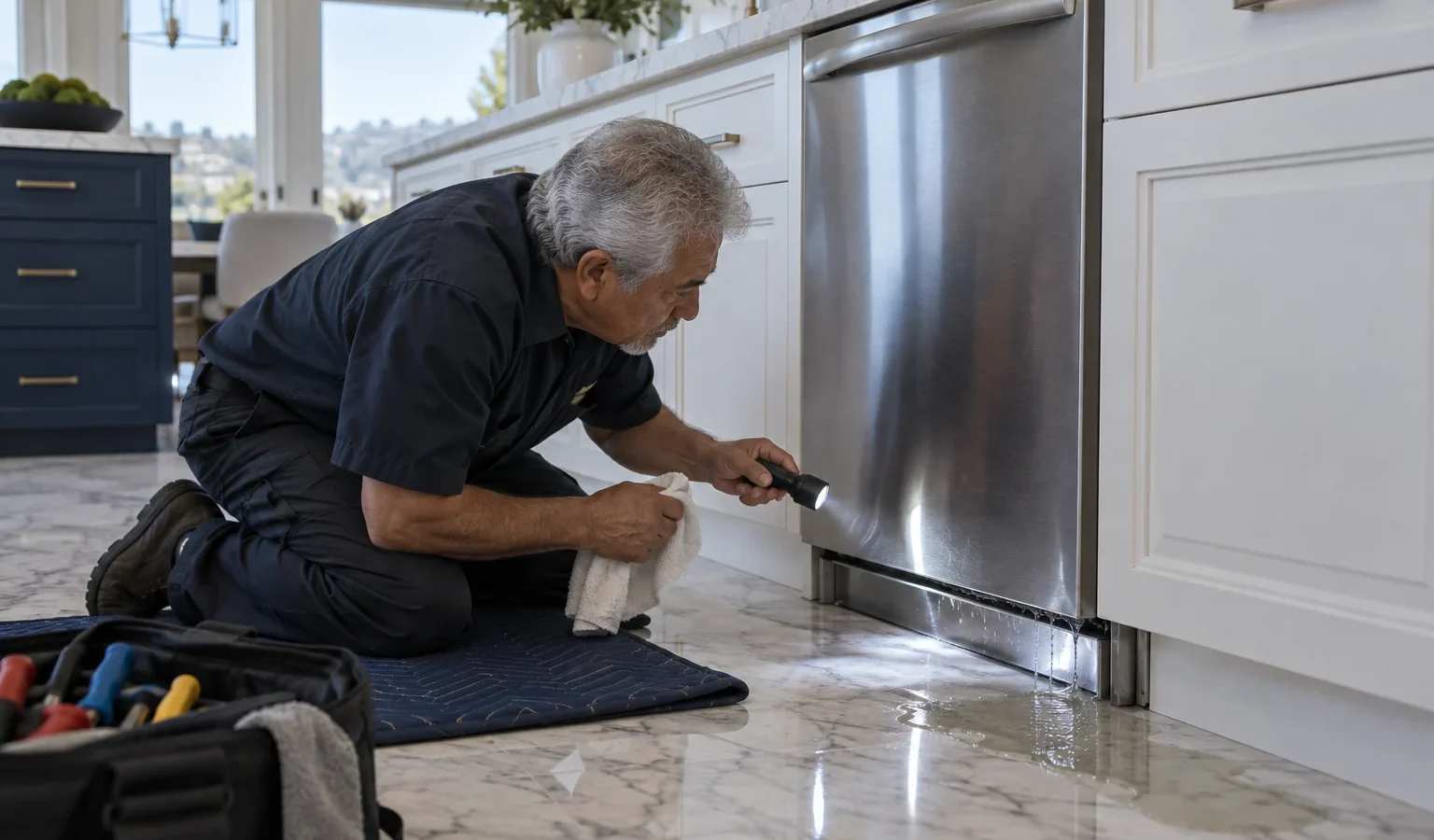
Water on the floor in front of a Thermador dishwasher can come from the door seal, a hose, the inlet valve or the pump area. Learn how to tell them apart and when to shut it off.
Thermador repair · San Francisco & the Bay Area
A leaking dishwasher is the one repair that should not wait. In a flat or condo the water goes through a flush cabinet, under a stone counter and down into a floor that someone else may own beneath you. Thermador dishwashers include leakage protection that notices water in the base and halts the cycle, but that system is the last line of defense, not a reason to ignore a damp floor.
Switch the dishwasher off at the breaker, close the water supply valve under the sink, and mop up. Then note three things: whether the leak shows up during filling, during washing or only after the cycle, whether the puddle is at the door edge or in the middle under the machine, and whether the display carries a code. Those three observations narrow the source quickly.
If water appears at the bottom corners of the door during washing, look at the door gasket for a fold, a tear, or a build-up of detergent film that stops it from sealing. On panel-ready models the heavy front panel changes how the door hangs, and a door that sags slightly can fail to compress the gasket evenly. A rack overloaded so a sprayer arm is blocked can also throw water out against the seal.
A drip that appears when the machine fills, or even when it is idle, may come from the supply connection or the inlet valve. The braided line and the shutoff valve are under the sink or beside the machine. If the leak keeps going after you shut the valve, you are looking at a different source.
The drain hose and its clamp can weep when a clamp loosens or a hose cracks. A blocked drain makes water back up and spill from places that are normally closed, so a leak with standing water in the tub deserves a drain check first. The page on a Thermador dishwasher that is not draining covers it.
Water in the base may come from a pump seal, a spray arm connection, a cracked sump component, or a heat pump area. Too much sudsing from the wrong soap can also overflow the tub. These are not owner repairs, and they are the reason leak-protection exists.
When the safety switch detects water in the base, the codes include E15 and E3100, and on units that display alternating pairs, E:30-00 and E:31-00, as leakage protection or the water protection system being activated. A related entry, E:34-00, says water is continuously running into the appliance, which also needs attention before the next cycle. See the broader dishwasher code guide for the neighbors.
One thing to know: the protection system may keep the machine from running until the water in the base is dealt with. Do not try to defeat it. Draining the machine while it sits tilted or unplugged is a job for a technician who can see what is wet.
Do not pull the dishwasher out by its hoses, remove lower panels, or try to dry out electronics with a heat gun.
In row houses and hillside homes the dishwasher is sometimes above a finished room, and water travels along joists before it shows. A cabinet base that has swollen means the leak has been present for a while. The sooner the source is found, the smaller the repair and the less drying out you need to do.
We start with the model number, the code history and the position of the water, then examine the door seal, the inlet valve, the pump area and the hoses with the unit safely accessed. We diagnose before any repair, give you a written estimate, and do nothing without your approval. For the full process, read Thermador dishwasher repair, and for the lineup see Thermador dishwashers. If your unit is a current DWHD640EPR or an older Sapphire, send the model number from the door frame.
When did the puddle first appear, and has anything changed in the kitchen recently? A new disposal, a moved dishwasher, a fresh cabinet panel, a different detergent or a plumber’s visit all leave fingerprints on a leak. Does the water show after every cycle or only after full loads? A leak that appears only with a heavy load can be a spray problem rather than a part failure. Jot down answers and bring the model number from the door frame or the inside wall of the tub; they shorten the diagnosis considerably.
Keep the supply valve closed and the breaker off until the visit. Slide a towel or a shallow tray where water collected, and look at the toe-kick area for dampness. If the cabinet next to the dishwasher feels soft or smells musty, mention it when you book so the inspection covers the surrounding area as well as the machine.
It is safer not to. A small leak under a built-in dishwasher is hidden by the cabinet, and damage to the floor and subfloor grows quietly.
That timing points to the fill side: the inlet connection or valve. Leaks late in a cycle suggest the pump or hose side instead.
Only when the gasket is the cause. Door alignment, overloaded racks and detergent film can also produce the same puddle.
Leave the machine off, close the supply valve and request a diagnosis. The code means water was found where it should not be.
Water in the base can reach pump parts and wiring. That is why quick shutoff and a careful inspection matter.
Share a few details and we’ll confirm an appointment. Prefer to talk? Call us and we’ll help right away.