

Specialized Thermador Appliance Repair in San Francisco
Mon–Sat: 8:00 AM – 7:00 PM
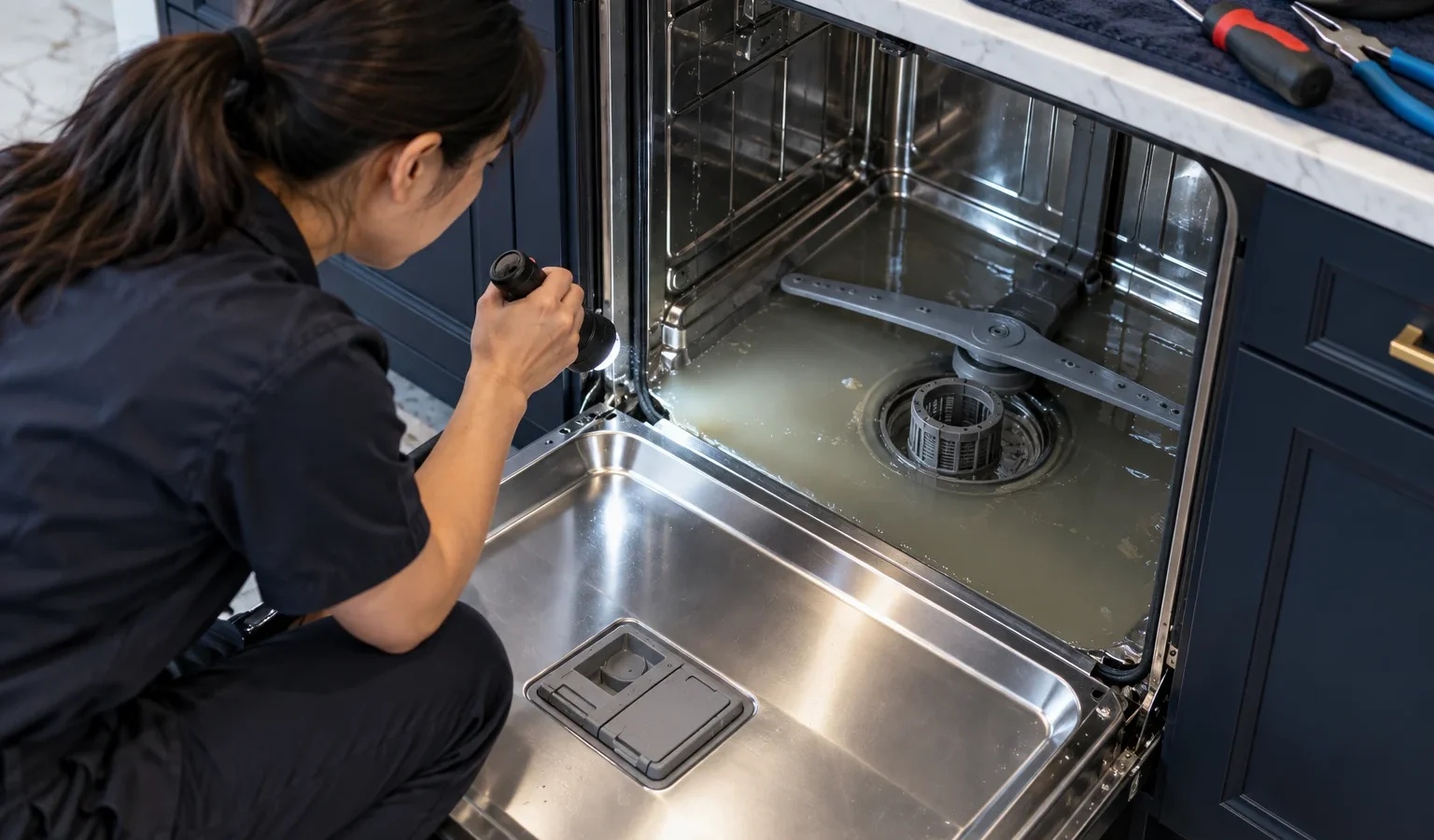
Standing water after a cycle usually traces to a clogged filter, a kinked hose, a missing high loop or a pump that has stopped moving water. Here is the order to check.
Thermador repair · San Francisco & the Bay Area
When a Thermador dishwasher finishes a cycle with water still standing in the tub, the drain path has stopped somewhere between the filter and the sink drain. The path is short: the water falls through the filter and sump, the drain pump pushes it up a hose, the hose rises to a high loop or an air gap, and the water leaves through the disposal or the sink tailpiece. A failure at any one point looks the same from the front, so the job is to find which point, and to do it in order.
Look at the water. Gray water with food bits means soil is sitting in the filter or the drain screen. Clear water with a faint soap film hints that the pump ran but the water could not leave, which points to the hose, the loop or the sink side. Water that is warm and has a burnt smell, or a hum from the base without any movement, suggests the pump motor is struggling. Noting what you see saves time at the visit.
A drain fault often arrives with a code. The code describes E22, E24 and E25 as a blocked filter, a blocked drain pump or loose cover, a kinked drain hose, or a clogged air gap or drain hose. E23 names the drain pump itself as blocked, clogged or faulty. If the display shows E:61-02 or E:61-03, treat it as a condition outside the machine first; both are described as not an appliance error. For the wider list see Thermador dishwasher error codes.
That is where the owner part stops. Do not take the machine out of the cabinet, do not remove lower access panels, and do not pour caustic drain cleaner into the tub. It can damage seals and splash into the machine.
Dishwashers in San Francisco flats and condos are frequently tucked under a stone counter with panel-ready doors, so the hose route is tight and the sink is shared with a disposal that the building or a previous owner installed. In older buildings the sink drain may be shared with other fixtures, and a slow house line looks like a dishwasher fault. We check the machine first and then the connection it drains into, so you do not pay for the wrong repair.
Call when water returns after a clean filter and a clear hose, when you hear the pump hum but nothing leaves, or when the same drain code reappears. Standing water that sits for days smells and can stain the tub, so do not leave it. If you notice a leak on the floor at the same time, shut the supply valve and read why a Thermador dishwasher leaks.
We look at the model number and the code history, test the pump and its drive with the unit safely accessed, trace the hose route and the air gap, and tell you what we found before anything is replaced. You get a written estimate, and no repair proceeds without your approval. More detail is on Thermador dishwasher repair, and the Thermador dishwashers guide shows where the model label usually sits. Owners of the discontinued Sapphire DWHD870WFM are welcome too.
A slow drain is not always the dishwasher’s fault, and it is not always the sink’s either. If the kitchen sink also empties slowly, a partial blockage in the house line can hold the dishwasher water back, and no pump replacement will change that. If only the dishwasher is affected and the sink runs freely, the cause sits in the machine’s own hose, pump or filter. Running the sink at full flow while the dishwasher drains is a simple way to see which side the trouble is on, and it is a detail worth passing on when you call.
A small film around the sump can be normal. Water that covers the filter or sits above it after the cycle ends is not, and it means the drain path is restricted.
Neither clears a blockage in the pump or hose. They only mask the smell. Remove the physical obstruction instead.
The drain line usually lacks a proper high loop, or the air gap is clogged. Either lets sink water come back toward the tub.
Over time it can stain the tub and encourage odor, and a pump that works against a blockage may wear faster. Deal with it promptly.
Yes, we look at the disposal connection, loop and air gap as part of the diagnosis, since the cause often sits there.
Share a few details and we’ll confirm an appointment. Prefer to talk? Call us and we’ll help right away.