Refrigerators
Built-in column and bottom-freezer Thermador refrigerators in San Francisco homes: what we see, where the model label sits, and what to check…

Specialized Thermador Appliance Repair in San Francisco
Mon–Sat: 8:00 AM – 7:00 PM
Warm shelves, frost on the back wall or a door that no longer seals: we find the cause in your built-in unit before any repair starts.
Thermador repair · San Francisco & the Bay Area
A built-in Thermador refrigerator sits flush with the cabinetry, often behind a panel that matches the kitchen, and it is expected to run quietly for a long time. When it stops cooling evenly, starts ticking, or leaves a puddle at the base, the fix rarely starts with the obvious part. We diagnose Thermador refrigerators in San Francisco and around the Bay Area, from column refrigerators in remodeled flats to bottom-freezer units in hillside houses, and we explain what we find before anything is repaired.
This is the classic split. Cold air for the fresh-food compartment is shared from the freezer side, so a blocked air path, a fan that has stopped or a damper that no longer opens can leave milk warm while the freezer stays frozen. A technician checks the evaporator fan, the air damper, the temperature sensors and whether frost has built up behind the back panel.
When nothing is cold, the question is whether the sealed system is running at all. We listen for the compressor and condenser fan, check the condenser area for lint and kitchen grease, and look at the control board and start components.
Heavy frost on the back wall, ice under the crisper drawers or water pooling at the bottom usually points to the defrost system: the heater, the sensor that ends the defrost cycle, or the drain that carries meltwater away. Our Thermador freezer frost buildup guide walks through the same pattern in detail.
Clicking, buzzing, rattling and loud humming each have a different usual cause, such as a fan blade touching frost, a loose drain pan or a compressor struggling to start. Built-in cabinets can carry the sound, so a touching toe-kick or loose panel is sometimes the real source. Read more in Thermador refrigerator making noise.
No ice, small or hollow cubes, slow filling and a dispenser that drips all trace back to the water supply, the inlet valve, a frozen fill tube or the filter housing. The Thermador ice maker not making ice article covers the owner-side checks.
Many Thermador refrigerators connect to Home Connect, and a lost connection on its own does not mean the cooling has failed. If the display is dark, shows an alert or the door alarm keeps sounding, we check the door switch, the gasket seal and the control board.
Where a refrigerator is installed matters as much as what is wrong with it. A built-in column is usually trimmed tight to the surrounding cabinets, and a panel-ready door carries extra weight on the hinges. That weight can pull a door slightly out of square, which breaks the gasket seal along one edge and lets warm air in. We check the door alignment, the hinge points and the gasket before we blame a cooling part.
Airflow around the cabinet is another factor. A unit boxed in without room around the condenser works harder and can run warm. Column refrigerators paired with a column freezer share trim, and we make sure the two are not rubbing each other.
On models with an ice maker, a water line kinked while the unit was pushed back, or a shutoff valve only partly open, can look like a failed appliance. In older buildings we also check that the floor has not settled and left the unit out of level.
Thermador refrigerators report a problem through a door alarm, a temperature alert or a message on the control panel. Write down exactly what the panel shows before you do anything else, including whether it blinks, beeps or stays lit. We do not publish reset sequences, and a reset that clears an alert does not fix its cause. Our general page how to reset a Thermador appliance explains what a single controlled power reset can and cannot tell you. For the codes we have verified on other Thermador appliances, see the Thermador error codes library.
Do not pull the unit out of its cabinet, remove interior panels, or open anything that belongs to the cooling system. Moving a built-in refrigerator can kink the water line or damage the trim, and the sealed system is not something to touch.
If you smell burning, see sparks or hear electrical crackling, switch the breaker off right away and keep the area clear. If water is running onto the floor or toward a nearby outlet, turn off the water supply valve and the power. When both compartments are warm and the unit makes no sound at all, a visit is the right next step.
Thermador builds several refrigerator layouts, including column refrigerators and bottom-freezer units, and the parts inside differ between them. The model number tells us which control board, fan, sensor and door hardware to expect. It is usually on the inside wall of the fresh-food compartment or along the door frame. Our article on how to find your Thermador model number shows where to look. Models we see regularly include the T24IR100SP and T24IR905SP column refrigerators and the T30IB102SP and T36BB110SS bottom-freezer refrigerators.
We start by listening to what happened and when it started. Then we check the symptoms in the order that makes sense for your layout: power and display, door seal and alignment, airflow and fans, defrost components, water supply if the unit has an ice maker, and finally the sealed system. You get a diagnosis first, then a written estimate, and nothing is repaired until you approve it. If a part has to be ordered, we tell you what is being waited for. We serve San Francisco and the surrounding Bay Area, and you can request a visit through the contact page.
Usually the cold air is not reaching the fresh-food side. A stopped evaporator fan, a stuck damper or frost blocking the air path are the common reasons. A technician checks each in turn and shows you what failed before suggesting a repair.
Often it is meltwater that cannot drain, because the defrost drain is clogged or frozen. That is a drainage fault in the defrost system, and the cure is different from replacing a water line. Tell us where the water appears.
You can check that nothing blocks the door and that the gasket is clean. Adjusting hinges on a heavy panel door is better left to a technician, because a wrong adjustment can twist the panel against the cabinets.
No. A lost connection affects the app, not the cooling. If the refrigerator still keeps food cold, the network is the first thing to look at.
Yes. We work in condos, flats, row houses and hillside homes across San Francisco and the Bay Area, and we plan access to the cabinet cutout and water line before the visit.
Built-in column and bottom-freezer Thermador refrigerators in San Francisco homes: what we see, where the model label sits, and what to check…
Built-in Thermador coffee machines that stop brewing, leak, froth poorly or flash a fault are diagnosed in your San Francisco kitchen, with…
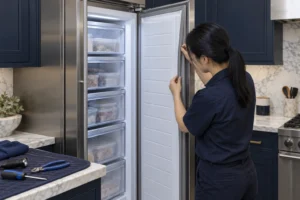
Repair diagnosis for Thermador column freezers with frost buildup, soft food, ice maker trouble or odd noises in San Francisco and Bay…
Burners that click without lighting, induction zones that go dark, griddles that stay cold or a glass surface showing a code: we…
A Thermador dishwasher that leaks, will not drain, shows a fault code or leaves dishes wet is diagnosed in your San Francisco…
Share a few details and we’ll confirm an appointment. Prefer to talk? Call us and we’ll help right away.