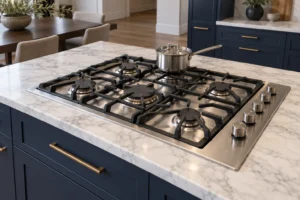
Cooktops and Rangetops
Induction, gas and rangetop Thermador cooktops in San Francisco kitchens: listed models, label spots, error codes, and safe checks before you book.

Specialized Thermador Appliance Repair in San Francisco
Mon–Sat: 8:00 AM – 7:00 PM
Gas, induction or electric, the surface that cooks your dinner is diagnosed in place and explained before any repair.
Thermador repair · San Francisco & the Bay Area
A cooktop or rangetop is the part of a Thermador kitchen that gets used hardest and noticed first. When a burner will not light, a zone goes dark halfway through a sauce or a glass surface starts throwing codes, dinner stops. We diagnose and repair Thermador induction cooktops, gas cooktops, gas rangetops and electric cooktops across San Francisco and the Bay Area, from flats with a single cutout over a cabinet to remodeled houses with a wide rangetop under a custom hood.
Thermador gas surfaces use the Star burner, and the ExtraLow simmer feature lets a flame stay very small. Both depend on a clean burner base, a seated cap and a spark module that reaches the electrode. A burner that clicks without catching is often wet, dirty or out of position after cleaning, and one that drops out after lighting can point to a worn igniter or a fouled port. Our post on a Star burner that keeps clicking walks through the pattern, and the burner that will not light article covers the full-failure case on a range.
Induction heats the pan itself, so the cooktop must sense cookware before it will switch on. Zones that refuse to start, stop mid-cook or will not join as a Flex Zone are traced from the control board down to the coil and its cooling path. If the surface does not recognize your pot at all, start with the induction pan detection guide before booking.
A griddle that stays cold while the burners work points to its own heating circuit or control. On electric cooktops, one dark element or a knob that does nothing leads to different parts. See griddle not heating for the symptoms in detail.
We begin with what you saw: which zone, and whether it followed a power flicker, a cleaning session or a new pan. Then we confirm the supply, read any code and compare the failing zone or burner with one that works. On gas models that means checking the cap and base, the spark path and the flame response. On induction it means checking the board, the coil, the thermal protection and the cooling fan beneath the glass.
You get a written estimate after the diagnosis, and nothing is repaired until you approve it.
These are the meanings we have verified for cooktops; each links to its own page.
More on induction faults is in induction cooktop error codes. Note which zone was lit when a code appeared.
Thermador cooktops are built in, so the cabinet and the space around the unit matter. A drawer or oven directly underneath leaves little room for heat to leave the electronics, so overheating codes on induction deserve a look at ventilation under the surface. A blocked or noisy cooling fan changes how we read a shutdown.
Gas rangetops and gas cooktops need a correct gas connection and a stable supply. The rangetop is often set under a wall, island or custom insert hood, so a hood that pulls hard can disturb a small flame at the lowest setting. If your cooktop talks to the hood or the home network, a Home Connect issue may show up as a code even when the cooking itself works.
Do not remove the glass, the burner base or any panel, and do not touch gas fittings or bypass a switch.
If you smell gas, leave the home, do not touch switches or lights, and call the gas utility or 911 from outside. If you notice a burning smell, sparks, a cracked glass surface or a zone that stays hot after you turn it off, turn the power off at the breaker and leave the unit alone until it is inspected.
Burner layouts, control boards and sensors differ between a thirty-inch induction cooktop, a gas cooktop and a wide rangetop, and parts are matched by model. Look for the label on the side of the rangetop or cooktop chassis, or on the underside of the unit where it is reachable, and send it with your request. The post on how to find a Thermador model number shows the usual spots.
Models we see most often in this family include the induction Thermador CIT304BB repair, CIT30FBG and CIT30YWBB, the rangetops Thermador PCG305W repair and PCG364WD, and the gas cooktops Thermador SGS305TS repair and SGS365TS.
You tell us the model, the symptom and any code when you request a visit. On arrival we protect the counters, look at the unit in place and talk through what we find. After the diagnosis you receive a written estimate, and the work starts only when you say yes. If a part has to be ordered, we explain what it is and why before you decide.
Where the problem also involves the hood above or the range below, we say so; those are covered in Thermador range hood repair and Thermador range repair. For the full lineup, see our guide to Thermador cooktops and rangetops.
The most common reasons are moisture or food residue at the burner base, a cap that is not sitting flat, or a dirty electrode. Let the burner dry, reseat the cap and try again. If it still clicks without catching, the igniter or spark path needs a technician’s inspection.
F1 means a cooking zone overheated and switched off to protect the work surface. F5 means hot cookware near the control panel put the electronics at risk, and the zone may switch off with a signal tone. Let everything cool, move the pan and try again; a repeat points to a diagnosis.
Usually the other zones still work, but a failed zone can be a sign of a board or sensor problem that may spread. If you notice heat where it should not be, smoke or a burning smell, power the cooktop off at the breaker and book a visit.
Often not. Many diagnoses and parts swaps are done with the unit in place. Some repairs under the surface need the cooktop lifted, which we would explain and include in the written estimate first.
Yes. Codes such as E7010 and E8204 to E8206 relate to the home network, the hood link and the wireless sensor. We check the connection, the sensor battery and the sensor itself before recommending any parts.
Induction, gas and rangetop Thermador cooktops in San Francisco kitchens: listed models, label spots, error codes, and safe checks before you book.
Built-in Thermador coffee machines that stop brewing, leak, froth poorly or flash a fault are diagnosed in your San Francisco kitchen, with…
Repair diagnosis for Thermador column freezers with frost buildup, soft food, ice maker trouble or odd noises in San Francisco and Bay…
A Thermador dishwasher that leaks, will not drain, shows a fault code or leaves dishes wet is diagnosed in your San Francisco…
Built-in microwaves, microwave drawers and speed ovens that run without heating, will not latch or show keypad faults are diagnosed in place…
Share a few details and we’ll confirm an appointment. Prefer to talk? Call us and we’ll help right away.