

Specialized Thermador Appliance Repair in San Francisco
Mon–Sat: 8:00 AM – 7:00 PM
The model number tells a technician exactly which appliance sits in your kitchen. Here is where the label usually hides on each type, and how to read it safely.
Thermador repair · San Francisco & the Bay Area
When you call about a repair, the first useful question is almost always the same: what is the model number? It sounds simple until you stand in front of a built-in appliance and find no obvious plate. Built-in kitchens are designed to look seamless, so the label is often tucked into a frame, a side wall or a place that only appears when something is pulled open. This guide walks through the usual spots appliance by appliance.
The model number identifies the exact appliance in your cutout. Two units that look alike from the front can differ inside in the parts they use and the way they are wired. With the number, a technician can prepare for the visit, understand what installation to expect and compare your symptoms with known behavior for that type. Without it, a first visit may be spent just identifying the machine. Do not decode the characters in the number yourself or assume they tell you the size or style; just copy the whole string exactly.
A serial number is a second, separate number that often sits on the same label. Record both if you can see them, but the model number matters most.
Look on the inside wall of the compartment, often near the top or along the side, or on the door frame where the door seals. Under-counter units may have it on the side wall inside or at the door edge. If a shelf or drawer covers the label, remove the item gently and put it back after you take a photo. See Thermador refrigerator repair for how we use the number on refrigeration visits.
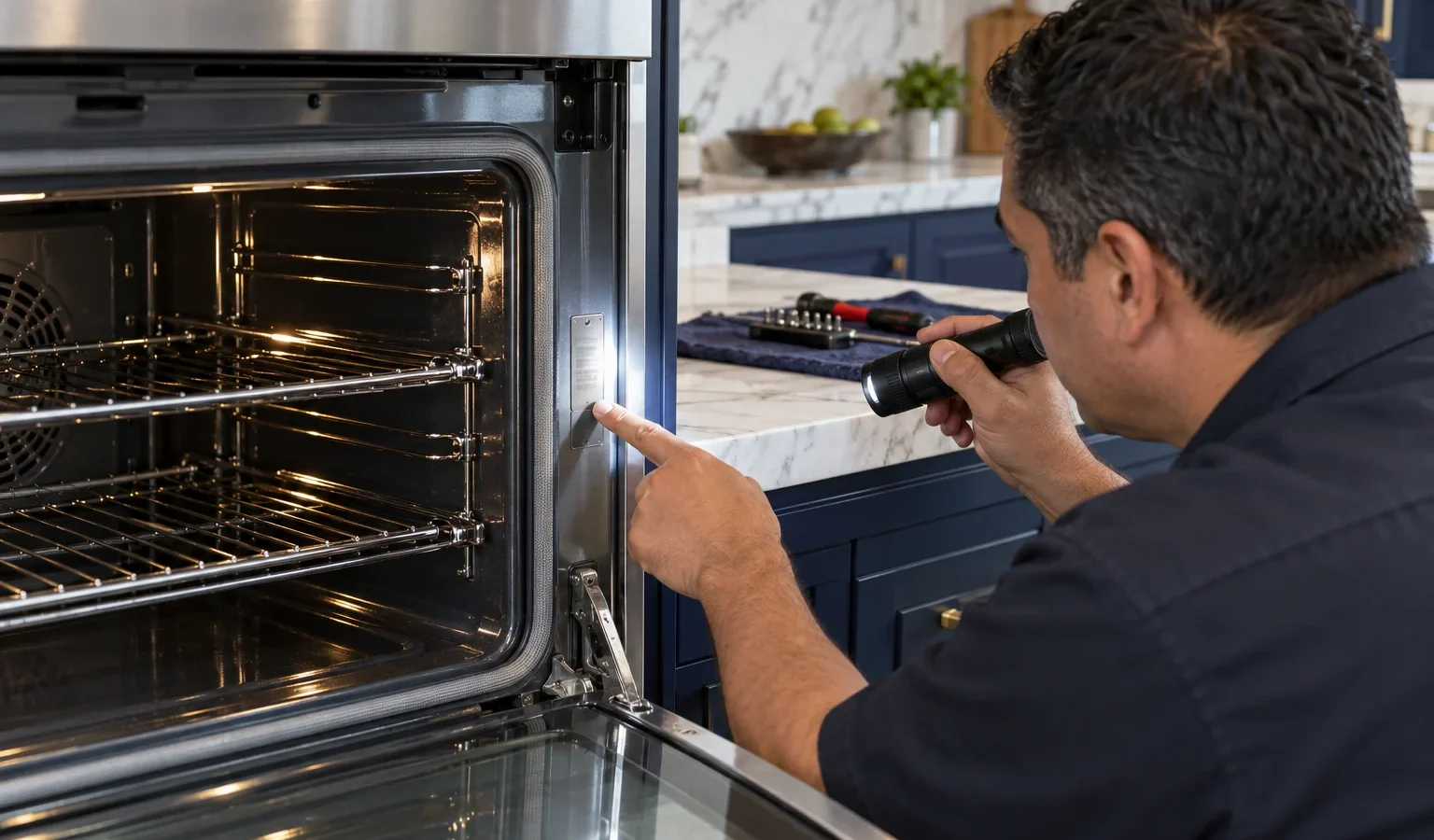
The label is usually on the oven frame, visible when you open the door fully, or along the edge of the front frame. Some ranges place it on the side of the cavity opening or in the storage drawer area. Steam and combi-steam ovens often have it on the frame behind the door seal. Our Thermador wall oven repair page shows what we need.
You usually find it on the underside or on the chassis. A drop-in unit may be impossible to inspect without lifting it, so check the installation papers, a cabinet door where manuals are stored, or photos from the remodel. If you cannot reach it, say so and we can identify the unit during the visit.
The label is often on the oven frame behind the door edge, or behind the drawer front edge when the drawer is pulled open. A microwave drawer or warming drawer may also show it along the side of the cavity opening. Remove the drawer contents before you look, and never reach inside while the unit is warm.
For canopy hoods, check behind the grease filters or on the inside of the canopy. Insert hoods and remote blowers can have the label on the blower housing, which may sit outside the cabinet or in a separate space. A downdraft often has a label on the cooktop’s chassis or on the vent module accessible from below.
On a dishwasher, open the door and look along the edge of the door liner or the side of the tub. On a built-in coffee machine, the label is typically on the side of the cavity opening or inside the front when the water tank is removed.
Do not pull out a built-in appliance to read a label on its back. They are heavy, tied to gas, power or water, and sometimes sealed against cabinetry. Do not remove panels or covers. If a label is only reachable with tools, leave it and let a technician handle it during the visit. If you smell gas while searching, leave the home, avoid switches, and call the gas utility or 911 from outside.
Once you have it, you can look up your model on our model pages. For example, the T24IR100SP page describes a column refrigerator, and the PODS301B page covers another unit in the range of ovens we see. If your model is not listed, do not worry; we service many models beyond the ones we show, and the number still guides the diagnosis. You can also browse all appliance types in our Thermador ranges and Thermador dishwashers sections.
If you have searched and still come up empty, send us photos of the appliance and its surroundings, along with the type, the location in the kitchen and the symptom. A technician can often identify the unit from its front and controls. The visit proceeds in the usual way: a diagnosis first, a written estimate, and nothing repaired without your approval.
Read more about our Thermador range repair and Thermador dishwasher repair visits.
The model number names the type of appliance, and the serial number identifies one particular unit. The model number is the one we ask for first.
Almost always. Labels are placed where an owner or technician can reach them without removing the unit from its cutout.
Yes, if the characters are readable. Include a second photo showing where the label sits.
Do not assume that. The model number alone does not tell you the age of your unit, and we do not guess it from the characters.
Check the paperwork from the install, then tell us what you can see. We can usually identify it during the visit.
Share a few details and we’ll confirm an appointment. Prefer to talk? Call us and we’ll help right away.