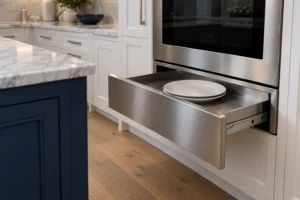
Warming Drawers
Thermador warming drawers in San Francisco kitchens: the two models we list, why drawers stop warming or jam, safe owner checks and…

Specialized Thermador Appliance Repair in San Francisco
Mon–Sat: 8:00 AM – 7:00 PM
A warming drawer sits quietly under a wall oven or beside a range until the night it matters. We look at the heat, the glides and the cabinet around them.
Thermador repair · San Francisco & the Bay Area
A warming drawer is one of the simplest-looking appliances in a Thermador kitchen, and one of the easiest to take for granted. It holds plates, bread and a roast at serving condition while the rest of dinner comes together, so a drawer that has gone cold usually reveals itself at the worst moment, with guests at the table. Our technicians repair Thermador warming drawers in San Francisco flats, condos, hillside houses and suburban homes around the Bay Area, and every visit starts with a diagnosis rather than a guess.
Complaints fall into a handful of groups, and the group tells us where to look first.
The display lights, the selector responds, and yet the interior stays cool. The cause may be a heating element that has opened, a thermal limiter that has tripped, a control that no longer sends power to the element, or a supply problem upstream of the appliance. Each of these looks identical from the front of the drawer, which is why we measure rather than assume.
A drawer that heats at the back but not at the front, or that takes far longer than it used to, points toward airflow and seal problems as often as toward a failing element. Packed contents, a warped liner or a worn gasket can all let warmth escape.
The glides, rollers and the drive that moves the drawer body carry real weight when the drawer is full of ceramic. A drawer that scrapes, tilts, binds halfway or rebounds open has a mechanical problem, and forcing it can bend the track or crack the front panel.
A dark display and no response may be a dead control, a tripped breaker, or a unit that lost its supply when the oven above it was serviced or the cabinet was reworked. We trace power from the panel to the appliance before we blame the drawer.
We start by asking how the problem showed up: after a power flicker, after a kitchen remodel, after something spilled, or slowly over several weeks. Then we read any message on the display and write it down, check the supply, and confirm that the drawer closes fully and engages whatever it needs to engage before it will heat. Only after those basics do we look at the element and the control. You receive a written estimate describing what we found and what the repair involves, and nothing is repaired until you approve it.
Many warming drawers show no code and simply stop warming, so the diagnosis rests on measurement; if yours shows one, our error codes page is the place to start.
Warming drawers are almost always built in, and the way they are built in matters more than most owners expect.
These steps stay on the outside of the appliance and take only a few minutes.
Do not remove the drawer front, open the cabinet behind it, or probe the wiring.
Switch the drawer off at the breaker and leave it off if you notice a burning smell, scorched food residue that will not clear, smoke, sparking, or a breaker that trips each time the drawer is switched on. A drawer that will not shut properly should also rest until it is looked at, since it can scrape the floor of the cabinet or tip its contents.
Thermador uses different warming drawer designs, and the part that fits one drawer will not necessarily fit another. The model label is usually found on the drawer frame or on the edge behind the drawer front, and sometimes only becomes visible when the drawer is pulled out. Photograph it before we arrive if you can, because it lets us bring the right parts the first time. The warming drawers we cover include the WD30W and the WD30WC, and our full lineup of Thermador warming drawers explains how to find the label on yours.
You request a visit through the contact form, and we agree on a window within our working hours, Monday through Saturday, 8:00 AM to 7:00 PM. We ask for the model number and a short description of the symptom beforehand. On site the technician protects your floor, pulls the drawer out far enough to see the glides and any label, runs the checks above again with proper instruments, and explains what was found in plain language. You then receive a written estimate. If you approve, the repair goes ahead; if you decline, you simply have the diagnosis. We never start work on a warming drawer, or anything else, without your approval.
If your drawer sits under a wall oven, the neighboring appliance often shares the same cabinet and sometimes the same supply, so it is worth reading about Thermador wall oven repair as well. For a step-by-step look at the most common complaint, see why a Thermador warming drawer stops heating, and for a broader view of symptoms across the whole kitchen try common appliance problems.
We work across San Francisco neighborhoods and the surrounding Bay Area, from tight row-house kitchens with limited parking to hillside homes where access means stairs. For the full list of areas, visit our service locations.
The usual suspects are a tripped breaker, a drawer that is not fully seated, a failed element or a tripped limiter, and a control that no longer sends power. A technician measures each in turn so that you are not asked to approve a part that was not the problem.
No. Switch it off at the breaker and leave it off. A burning smell can mean residue on the element, damaged wiring or an overheating component, and all three are reasons to stop until someone has inspected the drawer.
In most cases the drawer body can be drawn out for service without disturbing cabinetry, although a heavy custom front sometimes needs to come off the glides. We explain what is involved in the written estimate before any work begins.
The model number if you can find it, a note of when the problem began, anything that changed around that time, such as a remodel or a power outage, and clear access to the drawer with its contents removed.
Yes. The drawer and the oven share a cavity, so we check clearances and ventilation along with the drawer itself, and we mention anything about the oven that could be affecting the drawer.
Thermador warming drawers in San Francisco kitchens: the two models we list, why drawers stop warming or jam, safe owner checks and…
Built-in Thermador coffee machines that stop brewing, leak, froth poorly or flash a fault are diagnosed in your San Francisco kitchen, with…
Repair diagnosis for Thermador column freezers with frost buildup, soft food, ice maker trouble or odd noises in San Francisco and Bay…
Burners that click without lighting, induction zones that go dark, griddles that stay cold or a glass surface showing a code: we…
A Thermador dishwasher that leaks, will not drain, shows a fault code or leaves dishes wet is diagnosed in your San Francisco…
Share a few details and we’ll confirm an appointment. Prefer to talk? Call us and we’ll help right away.