
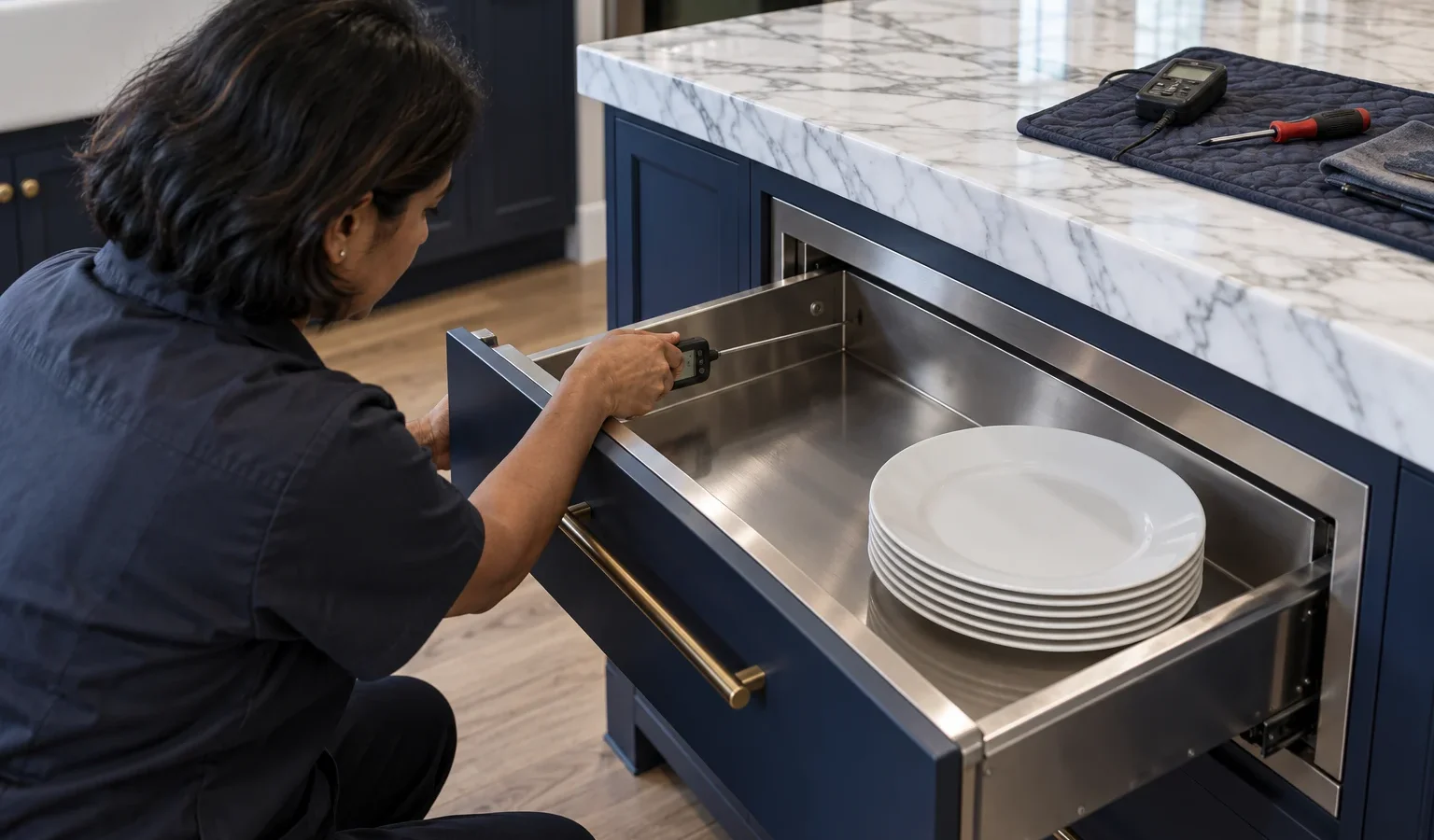

Specialized Thermador Appliance Repair in San Francisco
Mon–Sat: 8:00 AM – 7:00 PM
Plates come out lukewarm, dinner rolls go limp, and the drawer seems to be on. Here is how to sort control problems from heating faults and what to check yourself.
Thermador repair · San Francisco & the Bay Area
A warming drawer is quiet by design. It holds plates, bread and covered dishes at serving condition while the rest of dinner finishes, and it rarely demands attention. That is exactly why a failure is easy to miss. You pull out a stack of plates and they are barely warm. The drawer front looks normal, the control may even glow, yet the heat has gone missing.
Three situations look alike from the kitchen. In the first, the drawer was never actually turned on, or the control was left in a mode that does not call for heat. In the second, the drawer runs but loses heat to the room because the drawer is not closing fully. In the third, a heating or control part has failed. You can sort the first two out yourself; the third is the reason for a visit.
Ask yourself what changed. Did the drawer work well last week? Did anyone clean it, load it with something heavy, or slide the drawer in hard? Was there a power flicker, a trip at the panel, or work on the kitchen cabinets? Those small events explain most calls about drawers that seem to have lost their heat.
Do not run the drawer with food in plastic containers or foam packaging, and do not stack loads that touch the walls. Do not remove the drawer from its rails or open the housing to look at the element; the wiring beneath a built-in drawer sits close to the cabinet and is not a place for guesswork. Do not use a hair dryer or heater to warm plates in its place while troubleshooting inside the drawer. If you smell scorched dust or see smoke, turn the breaker off, leave the drawer closed and book a visit.
Warming drawers are often built in under a wall oven or beside a coffee machine, usually behind trim that echoes the cabinetry. Because the drawer is panel-ready in many remodeled kitchens, a heavy decorative front can pull the drawer slightly out of line over time, and a front that looks perfectly closed may still leave a slit along one side. Neighboring heat sources add to the picture; a drawer under a busy oven may seem warm even when its own heater is not working, which confuses the diagnosis. We take both into account before we blame a part.
We test whether the control asks for heat, whether power reaches the element, and whether the element and limiter respond. We also check the box alignment and the safety switch at the front. After diagnosis, you get a written estimate, and no part is replaced without your approval. If the answer turns out to be a closing issue or a setting, we say so and you go away with a working drawer.
The model number is usually behind the drawer front edge or on the side of the cavity opening. For examples of what we see, look at the WD30W and WD30WC pages.
Book when the drawer remains cool even though it is correctly set and closes properly, when the heat is uneven or weak despite plenty of time, when the control behaves erratically, or when a breaker trip coincides with use. Sooner is better if you smell something hot. Read about our Thermador warming drawer repair visit, or browse the Thermador warming drawers overview. If the oven above it also misbehaves, our oven not heating guide is the better place to begin.
Warm enough to keep food ready, not hot like an oven. Plates should feel pleasantly warm after the drawer has had time, and food should stay at serving condition without drying out.
Heat rises from the base. Tall stacks, heavy ceramic and a drawer that was not preheated all slow the process. It is not a fault if the gap narrows with more time.
An empty test is the cleanest way to judge the heat. Add the dishes once you know the drawer itself warms up.
Yes. A gap lets heat escape, and in some designs the drawer will not energize the element at all when its closing switch does not engage.
If it is empty and shows no signs of smell, noise or smoke, you may leave it off and wait. Do not use it for food warming until the cause is known.
Share a few details and we’ll confirm an appointment. Prefer to talk? Call us and we’ll help right away.