Wine Columns and Under-Counter Refrigeration
Thermador wine columns and under-counter refrigeration in Bay Area homes: the models we list, label locations, and what to check when temperatures…

Specialized Thermador Appliance Repair in San Francisco
Mon–Sat: 8:00 AM – 7:00 PM
Bottles do not forgive a unit that drifts. We trace the cause in your wine column or under-counter unit and tell you what we find.
Thermador repair · San Francisco & the Bay Area
A wine column or an under-counter unit is built to hold a narrow, steady range, not simply to be cold. A bottle can sit for a long time before a fault shows in the glass, so by the time you notice the display drifting or the door sweating, the unit may have been struggling for a while. We repair Thermador wine columns and under-counter refrigeration in San Francisco and around the Bay Area, and we diagnose first, so you can decide with the facts in front of you.
If the display shows one number and a thermometer inside shows another, the sensor, the control or the airflow is suspect. Overloading and bottles pressed against the rear wall also affect how the unit circulates air. Our article on Thermador wine column temperature swings goes through the pattern step by step.
A unit that never rests is often fighting dirty airflow, a failing door seal or a fan that has slowed. Short cycling can come from a control that reads the wrong temperature or a start device that is wearing out.
A little moisture is normal in humid weather. Pooling water, wet cartons or a drain that no longer clears points to a blocked drain path or a gasket that no longer seals. In a damp garage or a ground-floor wine room, the unit is working in tougher conditions than the one in an upstairs kitchen.
A dark display, flickering interior lighting or a door lock that will not respond may be a power or control problem. Because many Thermador appliances connect to Home Connect, we also check whether an alert reaching your phone was caused by a real fault or just a network lapse.
Buzzing, rattling bottles, a squealing fan and a thump at start-up all have different explanations. A unit that is not level, or that touches the cabinet beside it, transfers its hum to the room.
An under-counter unit is tucked below a countertop with little clearance, so airflow is often the issue before any part. If the front grille is blocked by a decorative panel, a stored box or a rug, heat has nowhere to go. We check whether the unit’s ventilation is what the cabinet design needs, and we look for a toe-kick that has been fitted too tight.
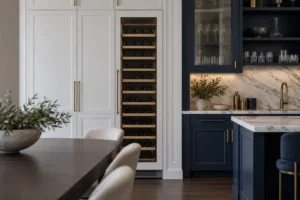
A wine column is a tall unit in a bank of cabinetry, sometimes beside a refrigerator column or a freezer. Spacing, trim and level are checked because a column that leans can stop its glass door from sealing evenly along the edge. Glass fronts and panel-ready doors add weight and show gaps more readily than steel.
Where a wine unit has a drain or a water connection, we trace the line for kinks, loose fittings or a drain path that has been covered. In older San Francisco flats, with long cabinet runs and uneven floors, levelness is worth checking before any part is replaced.
Thermador sells wine coolers and under-counter refrigeration in several layouts, and the control, fan, sensor and door hardware differ between them. The label is usually on the inside wall or along the door frame. Tell us the number when you book, or read how to find your Thermador model number for help locating it. Units we see include the T18IW100SP and T18IW905SP wine coolers and the T24UC905DP and T24UC915DS under-counter refrigeration units.
Do not open the back or the base of the unit, and do not touch sealed refrigeration lines. Dragging a built-in unit out of its cabinet often does more harm than the fault it was meant to find.
Wine is sensitive to constant vibration and to light, so a unit that hums or shakes deserves attention even when it holds temperature. Loose shelves, a fan blade touching the housing and a compressor mounted on worn pads can each be the source. We also consider the room: a unit near a sunny window, an oven or a dishwasher works against added heat, and a cabinet with no ventilation gap will run warmer than one with room to breathe. These details do not show on a display, so we look at them during the visit and tell you what we see.
A burning smell, sparks or crackling means the breaker should be switched off immediately. Water spreading across the floor from the unit calls for the supply valve and the power to be shut off if the unit has a water line. If the contents are valuable and the unit is clearly warming, move them to a stable cold place while you arrange a visit.
We listen to the history, check the readings and the air path, then inspect the door seal, fans, sensors, control and the cooling circuit in an order that matches what you describe. You receive a written estimate after the diagnosis, and no repair begins without your approval. For a visit in San Francisco or the surrounding Bay Area, use the contact page.
The sensor, the control or poor airflow can all cause this. Overpacking and bottles pressed against the back wall make it worse. A technician compares the display with a separate reading and traces the difference.
Light moisture in humid weather can be normal. Pooling water, dripping or damp cartons suggest a gasket or drain issue, and that is worth a visit.
Many people do, but those rooms put extra stress on the unit. If your unit struggles there, we look at airflow and ventilation as part of the diagnosis.
Check the breaker, the GFCI and whether the display is lit. If power is present and the unit is silent, a control or compressor fault is possible and needs a technician.
Yes. We check alignment, level and gasket contact before any cooling part, because a door that does not sit square is a common cause of drift.
Thermador wine columns and under-counter refrigeration in Bay Area homes: the models we list, label locations, and what to check when temperatures…
Built-in Thermador coffee machines that stop brewing, leak, froth poorly or flash a fault are diagnosed in your San Francisco kitchen, with…
Repair diagnosis for Thermador column freezers with frost buildup, soft food, ice maker trouble or odd noises in San Francisco and Bay…
Burners that click without lighting, induction zones that go dark, griddles that stay cold or a glass surface showing a code: we…
A Thermador dishwasher that leaks, will not drain, shows a fault code or leaves dishes wet is diagnosed in your San Francisco…
Share a few details and we’ll confirm an appointment. Prefer to talk? Call us and we’ll help right away.