

Specialized Thermador Appliance Repair in San Francisco
Mon–Sat: 8:00 AM – 7:00 PM
If a Thermador induction zone flashes, beeps or refuses to start with a pan on it, the cause is often the pan itself. Learn how to test it and when the cooktop needs service.
Thermador repair · San Francisco & the Bay Area
Induction cooking is unusual because the glass itself does not make the heat. The cooktop generates a magnetic field under the surface, and the pan reacts to it. If the pan is unsuitable, off-center or too small, the zone refuses to start, and the display usually blinks or beeps to say so. That behavior is not a defect. It becomes one when a pan that worked yesterday is ignored today.
Take the pan that fails and try it on a second zone. Then take a different pan you know works and try it on the first zone. The results sort the problem quickly:
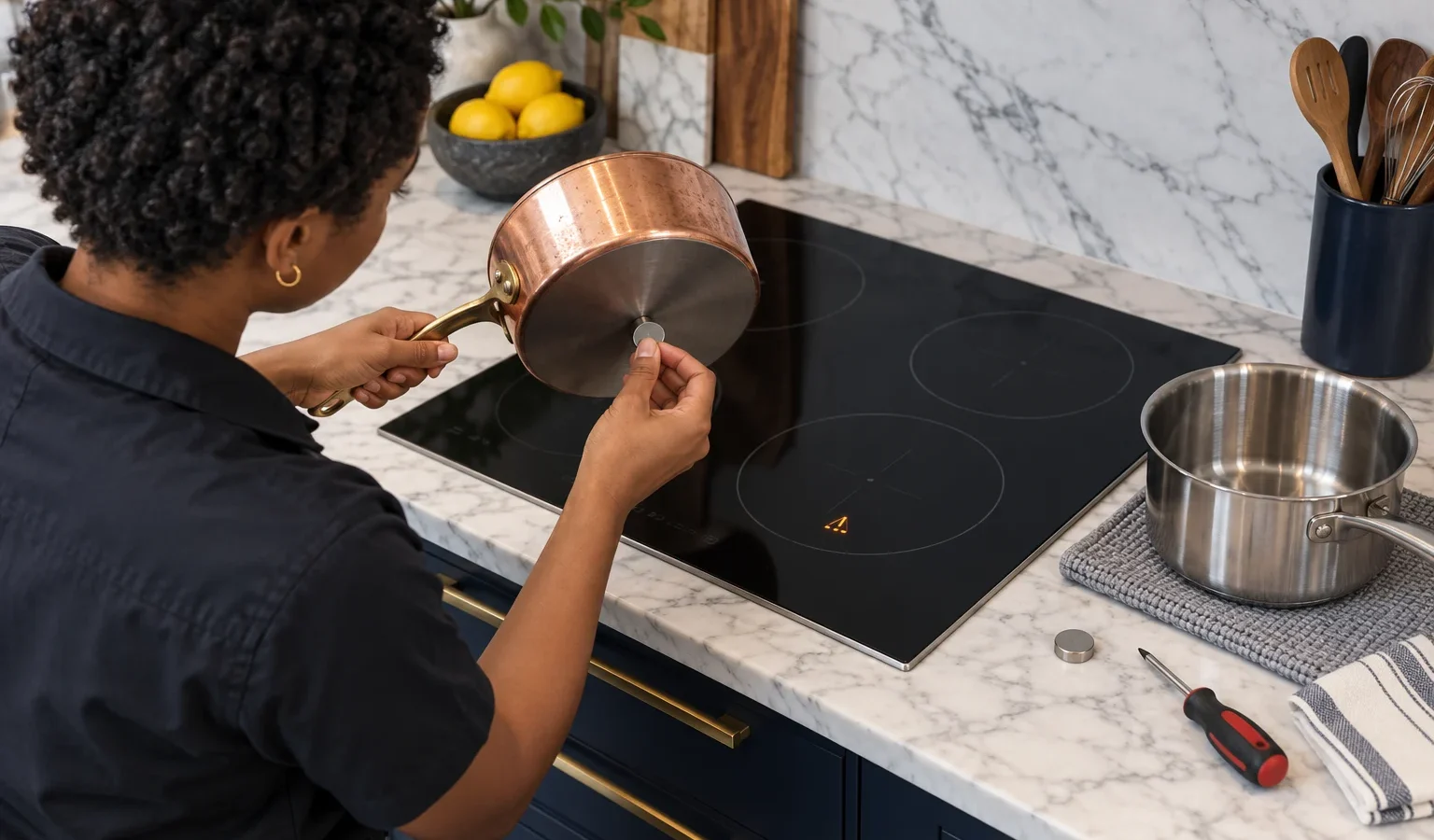
Induction responds to cookware that reacts to a magnetic field. Cast iron and many stainless steel pans do. Aluminum, copper and glass usually do not, unless they have a special base layer. A simple check is to hold a magnet to the underside: if it sticks firmly, the pan is a candidate. Cookware marked for induction is made for this.
A pan that is too small for the zone, or sits off to one side, may not be sensed. Center it over the marked ring. A large pot that overlaps two zones can confuse the sensing. If your cooktop has an extended Flex Zone, the pan placement rules there are different, and the manual explains them.
Pans warp over time. A bottom that bows up leaves a gap, which weakens the connection, and a rocking pan can lose contact. Place a straight edge across the base to see whether it is flat. Roughened or burned-on residue can also cause trouble, so wipe the bottom clean.
Boiled-over liquid, a film of cleaner or a water drop on the touch controls can interrupt the pan sensing and the touch response. Wipe the surface and the controls, dry them, and try again.
If a pan that clearly suits induction is ignored on one zone but works on others, suspect that zone. If every zone is ignored, the electronics, the power supply or a setting may be responsible. Check the display for these:
Our guide to induction cooktop error codes explains the rest.
When the failure appears matters. A zone that ignores pans from the very first moment of the day suggests a setting or a power issue. A zone that works for a while and then drops the pan mid-cook suggests heat, a warped base or a sensing fault that appears when parts warm up. Intermittent failures are the hardest to catch, so tell us what happened right before the pan was lost.
Do not lift the glass, open the housing or probe the controls. Do not place metal tools, foil or a wet cloth on a zone to coax it on. Do not keep pressing the touch controls when a code is active. And do not use a cracked glass surface. A crack lets liquid reach the electronics, so switch the cooktop off at the breaker and arrange a visit.
Many induction cooktops sit in stone or quartz counters over a drawer or a built-in oven, which limits airflow under the unit. A cooktop that works fine until a long simmer and then stops sensing may be reacting to heat or to restricted ventilation underneath. If a hood is paired with it, a communication change after a remodel can also confuse the display. We look at both the cooktop and its surroundings. Models in our list include the CIT304BB, the CIT30FBG and the CIT30YWBB, all induction cooktops. The model label is usually on the side of the chassis.
If every pan you own fails on one zone, if the problem began after a spill or a power event, or if a code returns after a reset, book a visit. We start with the pan and the placement, then test the zone, the sensing and the control, in that order. You receive a written estimate and nothing is repaired without your approval. Our Thermador cooktop repair page explains the service, and the cooktop and rangetop guide lists the models we handle in San Francisco and the Bay Area.
Flashing generally means the zone does not sense a suitable pan. Check the material, center the pan, make sure the bottom is flat and clean, and try the pan on another zone.
You need cookware that reacts to a magnetic field. A magnet sticking firmly to the bottom is a simple test, and cookware marked for induction is made for it.
If good pans work elsewhere and fail on that zone, the zone or its sensing may be faulty. Clean the glass and try again, then book a diagnosis if it persists.
Yes. Liquid or cleaner on the glass or the touch controls can interrupt the sensing and the response. Dry the surface fully before retrying.
Check for dE, which means demo mode, then do one controlled reset at the breaker. If the cooktop still refuses every pan, the electronics need to be tested.
Share a few details and we’ll confirm an appointment. Prefer to talk? Call us and we’ll help right away.