

Specialized Thermador Appliance Repair in San Francisco
Mon–Sat: 8:00 AM – 7:00 PM
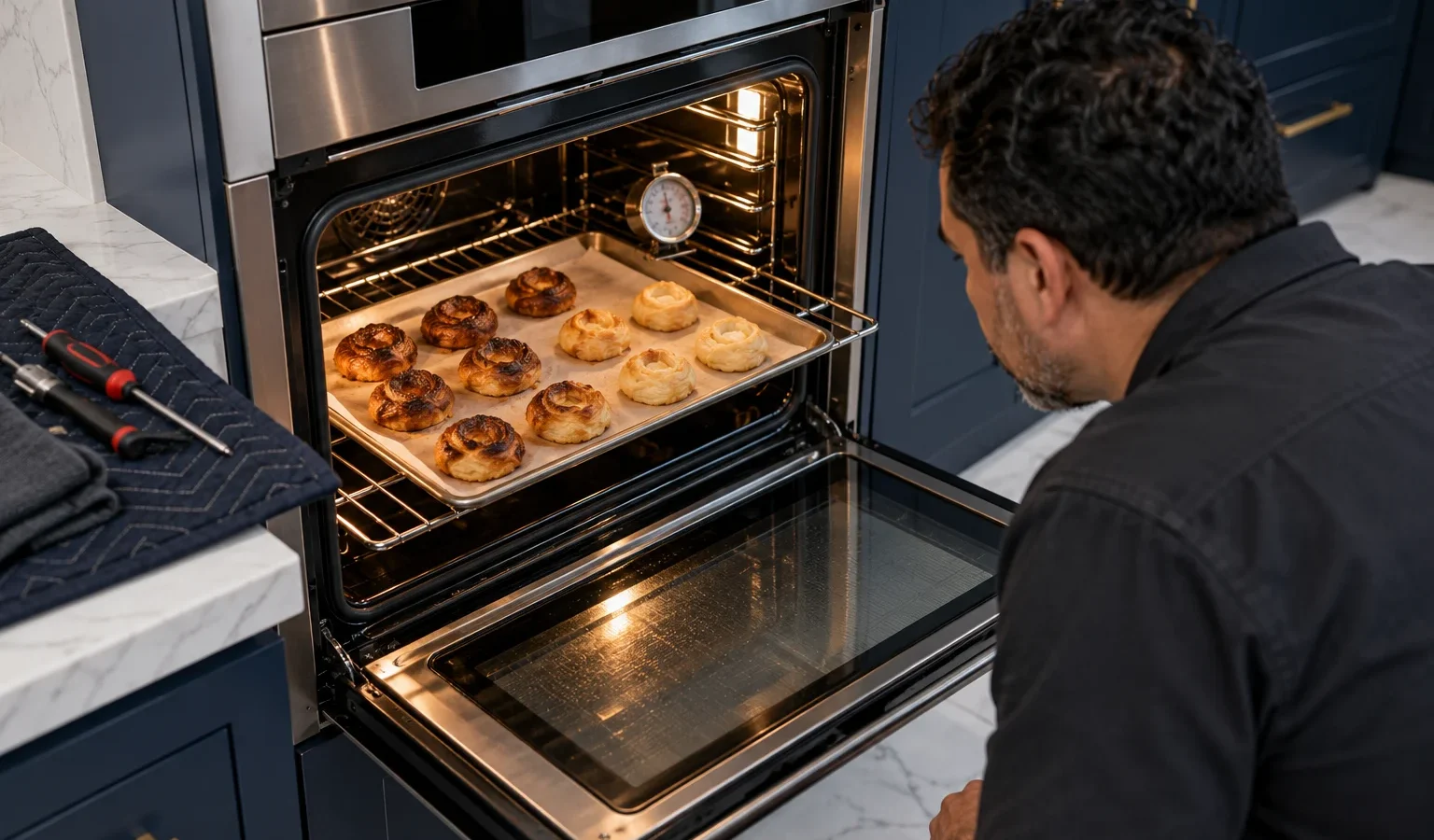
When roasts burn or cakes stay raw, the oven may be reading its own temperature wrongly. Here is how sensors, elements and airflow combine to throw cooking off.
Thermador repair · San Francisco & the Bay Area
Cooking that no longer matches the setting is one of the most irritating oven complaints, because the oven looks fine. The display shows a number, the preheat tone sounds, and yet the cake is raw in the middle or the roast is dark outside. In a wall oven the number on the display comes from a temperature sensor, and the heat comes from elements or burners that the control switches on and off. If the sensor misreports or the heat is unevenly delivered, the cooking falls out of step.
Food browns too fast and preheat seems quick. A sensor that reads low makes the control keep heating. The codes include E104 / E204 for a shorted temperature sensor and E115 / E215 for temperature in the unlocked cavity being too high, both of which deserve prompt attention.
Preheat takes a long time, baked goods stay pale, and the oven seems to give up before the food is done. A weak or failed element, a sensor that reads high, or a door that does not seal well can all cause this. E101 / E201 describes an open sensor circuit.
One side of a tray is done before the other. That usually points to airflow or element behavior: a convection fan that has slowed, a blocked vent, a worn gasket, or a rack position that blocks circulation. Our guide on a cooling fan that keeps running deals with the separate cooling system, which is not the same as the convection fan.
The sensor is a small probe in the cavity. It does not take the oven’s temperature as a thermometer would; it changes its electrical behavior with heat, and the control translates that. If the sensor drifts, the control still obeys it faithfully. That is why an oven can cook visibly off the setting and still show no code at all. A technician checks the sensor’s response against the control’s reading rather than trusting the display.
Do not adjust internal wiring, open the rear panel, or move the sensor. A displaced sensor can give false readings, and a wall oven is wired into the house supply.
A wall oven in a tight cutout, perhaps beneath a microwave or above a warming drawer, relies on cooling airflow around its housing. Poor ventilation can push the electronics toward overheating, with codes such as E003 or E303, and may disturb the control’s behavior. Double and triple wall ovens have separate sensors for each cavity, so a difference between cavities is a useful clue. In older Bay Area homes with remodeled kitchens, the oven sometimes sits slightly out of level, which can matter for uneven browning, though it rarely explains a large error.
Book when your thermometer disagrees with the display, when a sensor or high-temperature code appears, or when the oven shows uneven results with the same settings you always used. We confirm the model, test the sensor and heating path, and explain the finding before anything is replaced. You get a written estimate, and nothing is repaired without your approval. See Thermador wall oven repair for how a visit runs and the Thermador wall ovens guide for the lineup. Single units such as the ME301YP and double units such as the ME302YP are common in our calls. The full list of display messages is in the oven error code guide.
Before blaming the oven, consider the way heat reaches the food. Dark pans absorb more heat than shiny ones, glass dishes hold warmth longer, and a very full oven blocks airflow. Opening the door repeatedly lets heat escape and forces the control to recover. Preheating also matters: the preheat tone shows that the sensor reached the set point, but the walls and racks may still be catching up, so food placed immediately can cook differently from food placed after a pause. If your results changed suddenly with the same pans and recipes, the oven is the likelier cause.
We compare the display against a thermometer reading inside the cavity and watch how the oven cycles its elements. A big gap between display and reading points to the sensor or control. A good match with uneven results points to airflow, element wear or the door seal. Either way you hear the finding before any repair is discussed.
Pay attention to the symptoms around the temperature. A display that flickers, a preheat that never finishes, a door that feels hotter than normal, or a fan that runs far longer than before suggest the control is under stress. Report those along with the cooking results, since together they tell a clearer story than any single clue.
If you can, note which rack, which pan and which setting produced the odd result, and whether a double oven behaved the same in both cavities. A few written observations make the difference between a general complaint and a clear pattern, and they let us go straight to the sensor, the heating parts or the airflow.
Yes. A sensor that drifts slowly may stay inside the range the control accepts, so no code appears even though the temperature is wrong.
An offset setting on the control may be described in your manual, but it only masks a problem. If the cooking is far off, have the sensor tested.
Each cavity has its own sensor and heating parts, so they can drift separately.
It can. A gasket that leaks lets heat escape and shifts the oven cooler, especially near the door.
If it runs far above the setting or a high-temperature code appears, switch it off at the breaker and request a visit.
Share a few details and we’ll confirm an appointment. Prefer to talk? Call us and we’ll help right away.