

Specialized Thermador Appliance Repair in San Francisco
Mon–Sat: 8:00 AM – 7:00 PM
A locked wall oven door after cooking or cleaning can be normal for a while, or a sign that the latch or door switch is stuck. Learn how to tell the difference.
Thermador repair · San Francisco & the Bay Area
A wall oven door that refuses to open can be perfectly normal or a real fault, and the difference matters because forcing a stuck door can bend the hinge or break the latch. The door lock exists for safety: during certain high-heat functions the control keeps the door closed until the cavity has cooled enough. So the first question is simply whether the oven is supposed to be locked right now.
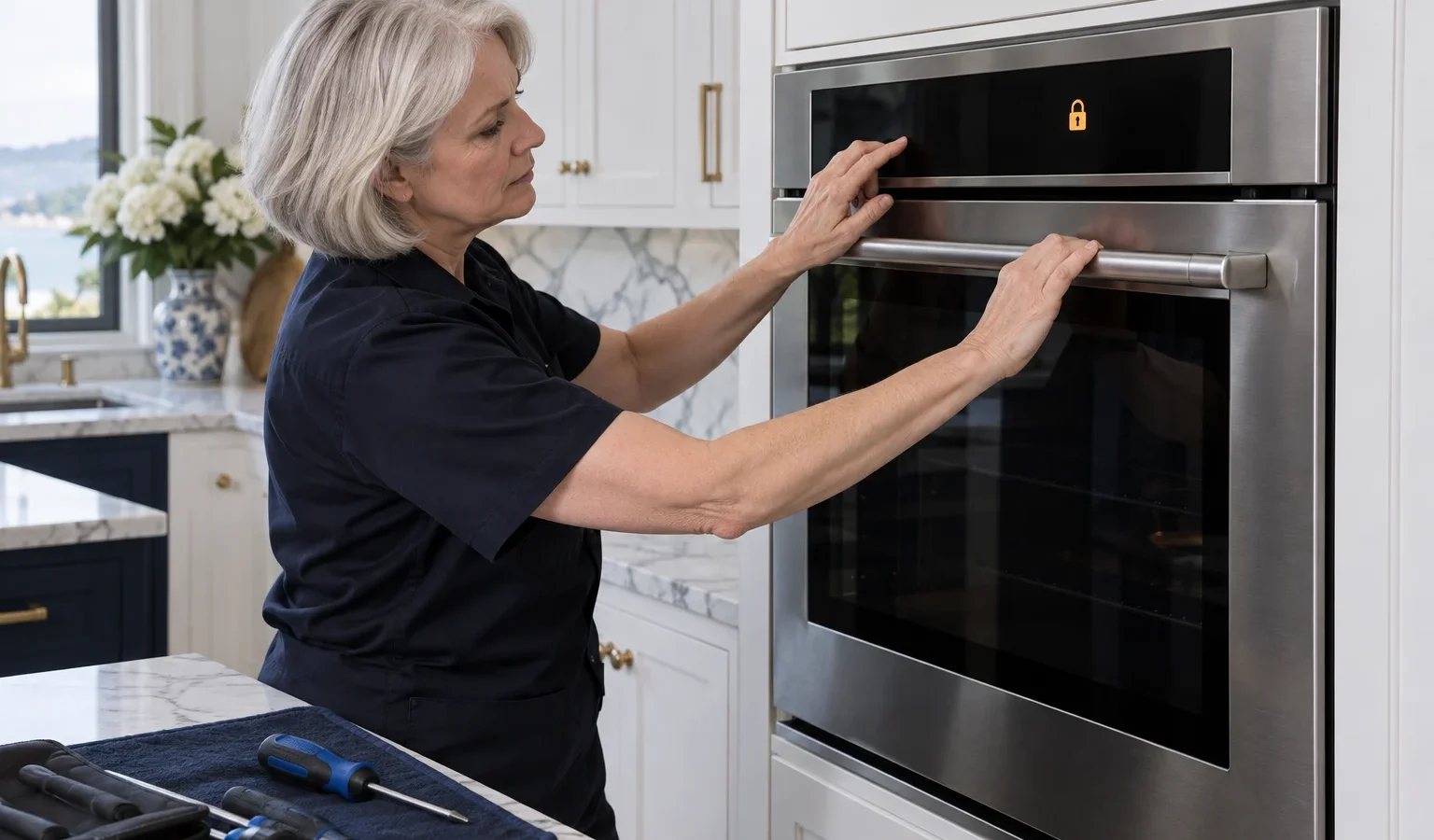
If the oven has just finished a cleaning function or a very hot cooking mode, the lock may stay engaged until the cavity has cooled, and the display usually shows a lock indicator. Wait, keep clear of the door, and let the oven finish its cooldown. A door that is simply hot to the touch should also not be pried. Check the display and the manual for the cleaning or lock behavior of your model before treating it as a fault.
It becomes a fault when the lock indicator stays on long after the cavity is cool, when the motor sounds as if it is trying and failing, when the door will not lock at all and the oven refuses to start, or when the display shows a latch code. The code meanings are specific:
In a double or triple oven, the first digit tells you which cavity: E1 for cavity 1 and E2 for the lower cavity of a two-cavity unit. Write down the exact text, because the pair changes the diagnosis.
The lock is a small motor-driven latch with a switch that reports its position. Heat cycling, spilled food that reaches the door area, a bent door or a latch hook that no longer lines up can stop it from traveling fully. If the switch cannot confirm the position, the control cannot decide whether the door is safe to open, and it may keep it locked or refuse to start. A control that has lost its mind about the door is also possible, which is why a communication code like E005 can sit beside a door complaint.
If the door remains stuck, leave it and book a visit. A door locked on a double oven may only affect one cavity, so the other may still be usable if it has no codes.
Wall ovens in tall cabinets or towers often have a flush surround that leaves little room to see or reach the latch. A door that has been slightly misaligned by a heavy panel, a re-hung cabinet door nearby, or an oven that was installed a touch out of square can load the latch unevenly. Technicians check hinge position and the strike alignment as well as the lock motor and switch. This matters in homes where a kitchen was remodeled around the oven.
We confirm the model number, usually on the oven frame, read the stored faults, and test the latch, switch and control, explaining what we find before anything is replaced. You receive a written estimate, and nothing proceeds without your approval. See Thermador wall oven repair for the process, the Thermador wall ovens guide for the lineup, and the oven error code guide for neighboring messages. Whether you own a MED301LWS or a double ME302WS, we can look at it.
Many owners meet the lock for the first time after a cleaning function. If your oven has one, expect the door to stay locked through the cycle and for a stretch afterward. Interrupting the cycle with the panel does not unlock the door instantly, because the control waits for the cavity to cool. A door that was locked before a power flicker may also stay locked until the control restarts and re-reads the latch. Be patient before deciding the lock is broken.
If the oven door looks crooked, drops when opened, or rubs against the frame, the latch may be fighting a misaligned door. A rattle from the lock area or a clicking sound that repeats without the door freeing are also signs the mechanism is working against something. Report what you hear along with the display message.
Until the cavity has cooled enough for the control to release it. If it never releases even when the oven is cool, the latch or switch needs a look.
Cutting power may not release a latch that is mechanically stuck, and it can leave it in an unknown state. Use it once as a reset, not as a way to force the door.
Usually yes if it has no code and heats normally, since the cavities have separate latches and sensors.
The control cannot tell whether the latch is locked or unlocked, so it cannot trust it. That points to the latch, its switch or the wiring.
The lock itself is rarely the danger; forcing the door is. A stuck latch can also stop the oven starting, which protects it.
Share a few details and we’ll confirm an appointment. Prefer to talk? Call us and we’ll help right away.