
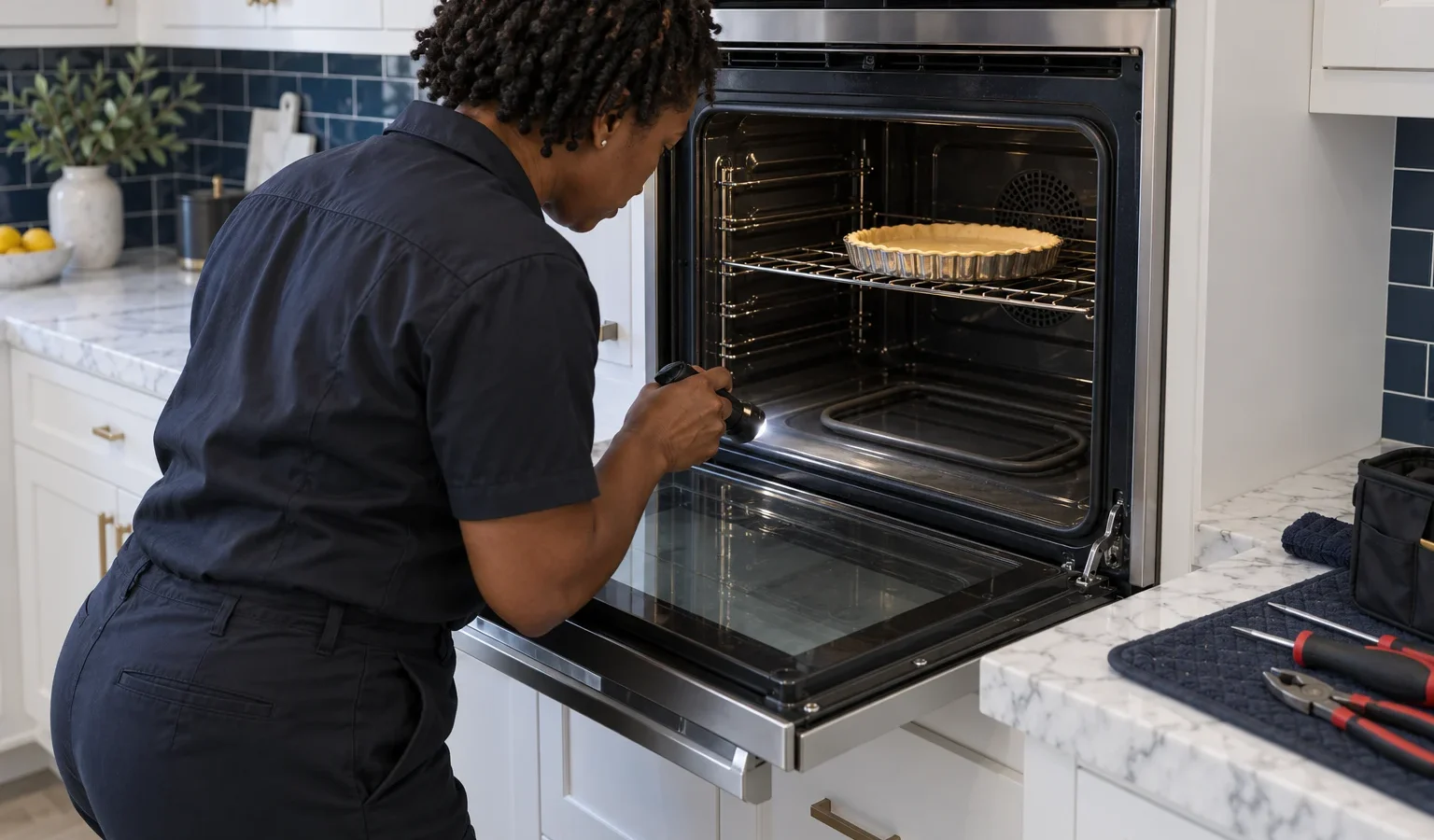

Specialized Thermador Appliance Repair in San Francisco
Mon–Sat: 8:00 AM – 7:00 PM
A wall oven that lights and beeps but stays cold may have a sensor, a heating element, a door lock or a control issue. Learn the order to check and what to leave alone.
Thermador repair · San Francisco & the Bay Area
A Thermador wall oven that does not heat can have a surprising range of causes, and some of them have nothing to do with the heating parts. The oven needs power to the control, a door it believes is closed and safe, a temperature sensor that reads sensibly, and elements or a gas supply that actually deliver heat. If any one of those fails, the cavity stays cold while the display looks perfectly happy.
Start with the display. If the panel is dark, the problem is upstream: a breaker, a power supply connection, or the control itself. If the panel lights and accepts a setting but the oven stays cold, a heating or safety condition is stopping the cycle. If it heats weakly or only in one cavity of a double or triple unit, think sensor or one failed element. A running cooling fan with no heat tells you the oven is trying to cook but cannot.
Stop there. Do not unscrew the interior panels, do not poke at the elements while the oven is powered, and do not try to bypass the door switch to force it to heat. Gas-fed ranges are a separate case, covered in the range oven not heating guide.
Wall ovens sit in cabinet cutouts, sometimes in towers with a microwave or warming drawer above, and the electrical feed comes from a junction behind or beside the cutout. Tight cutouts limit airflow, so overheated electronics can be a symptom of poor ventilation rather than a failed board. In older Bay Area homes remodeled around a new oven, we also examine the feed and the breaker pairing, because a mismatched circuit can mimic a failed element. Double and triple units may have separate controls for each cavity, which is why an oven that heats in one cavity but not another narrows the fault immediately.
Stop if you smell burning, see smoke or sparks, or if the oven trips its breaker. Switch it off at the breaker and leave it off. A smell of gas near a gas appliance means leave the home, avoid switches, and call the gas utility or 911 from outside.
We start with the model number, which is usually on the oven frame, and the code history. We then check power at the unit, the sensor, the element or ignition path, the door lock and the control, in that logical order. You get a written estimate, and no repair begins without your approval. Details are on Thermador wall oven repair, the Thermador wall ovens guide covers the lineup, and models such as the double MED302LWS and triple MEDMCW31WS are all in our scope. Read the oven error code guide for what the display may be saying.
Did the oven stop heating suddenly, or fade over weeks? A sudden loss points to a failed part, a tripped breaker or a lock fault. A gradual fade points to an element wearing out or a sensor drifting. Was a self-cleaning or high-heat function used shortly before? Heavy use of cleaning can strain latches and elements. Did a power event, a kitchen remodel or work on the breaker panel come just before? Any of those can change the supply to the oven, and the oven may be a victim rather than the cause.
Most Thermador wall ovens are electric, so the heating parts are elements. Ovens that include a microwave or speed oven function have an additional control path, and if only the oven part fails, the other function may keep working. Tell us which functions still work. It narrows the fault faster than anything else you can offer.
Ovens with several functions can look cold when you pick a mode that heats from a different source or that preheats quietly. Before concluding the oven is dead, select a plain conventional bake, set a moderate setting, and wait for the preheat tone. If your oven includes a steam, microwave or speed function, those modes do not heat the same way and may feel quite different at the front. A plain bake is the cleanest test of whether the main heating path works.
The control has power but a safety, sensor or heating condition is stopping the cycle. A diagnosis finds which one.
Yes. If the control cannot tell the door is closed, it may hold off heating as a safety measure.
Element repair is common and usually practical. We confirm the cause first and give a written estimate so you can decide.
Each cavity has its own sensor and heating parts, so a single failed component points to that cavity.
If it heats normally and shows no hot-electronics or burning signs, you may, but ask us when you book.
Share a few details and we’ll confirm an appointment. Prefer to talk? Call us and we’ll help right away.