

Specialized Thermador Appliance Repair in San Francisco
Mon–Sat: 8:00 AM – 7:00 PM
When one burner or every burner on a Thermador range refuses to light, the clues are in the sound and the pattern. Learn what to look at and what to leave alone.
Thermador repair · San Francisco & the Bay Area
Few kitchen problems feel as urgent as a burner that will not catch while a pan of water sits waiting. On a gas Thermador range the failure usually belongs to one of two groups: the burner is not receiving a spark, or it is receiving a spark and no gas, or gas that cannot reach the flame ports. Telling these apart takes about a minute of listening, and it saves a lot of guessing.
If you smell gas at any point, do not turn anything on or off. Leave the kitchen, and call the gas utility or 911 from outside. Do not look for the leak yourself. Everything else in this article assumes there is no gas odor.
Silence usually means the igniter circuit is not being powered. A tripped breaker, a range that lost its power during a storm outage, a controller that needs a reset, or a failed spark module can each produce it. If the clock and display on the oven side are dark too, think power first. If the display is alive and the burners are silent, the problem sits deeper in the ignition circuit.
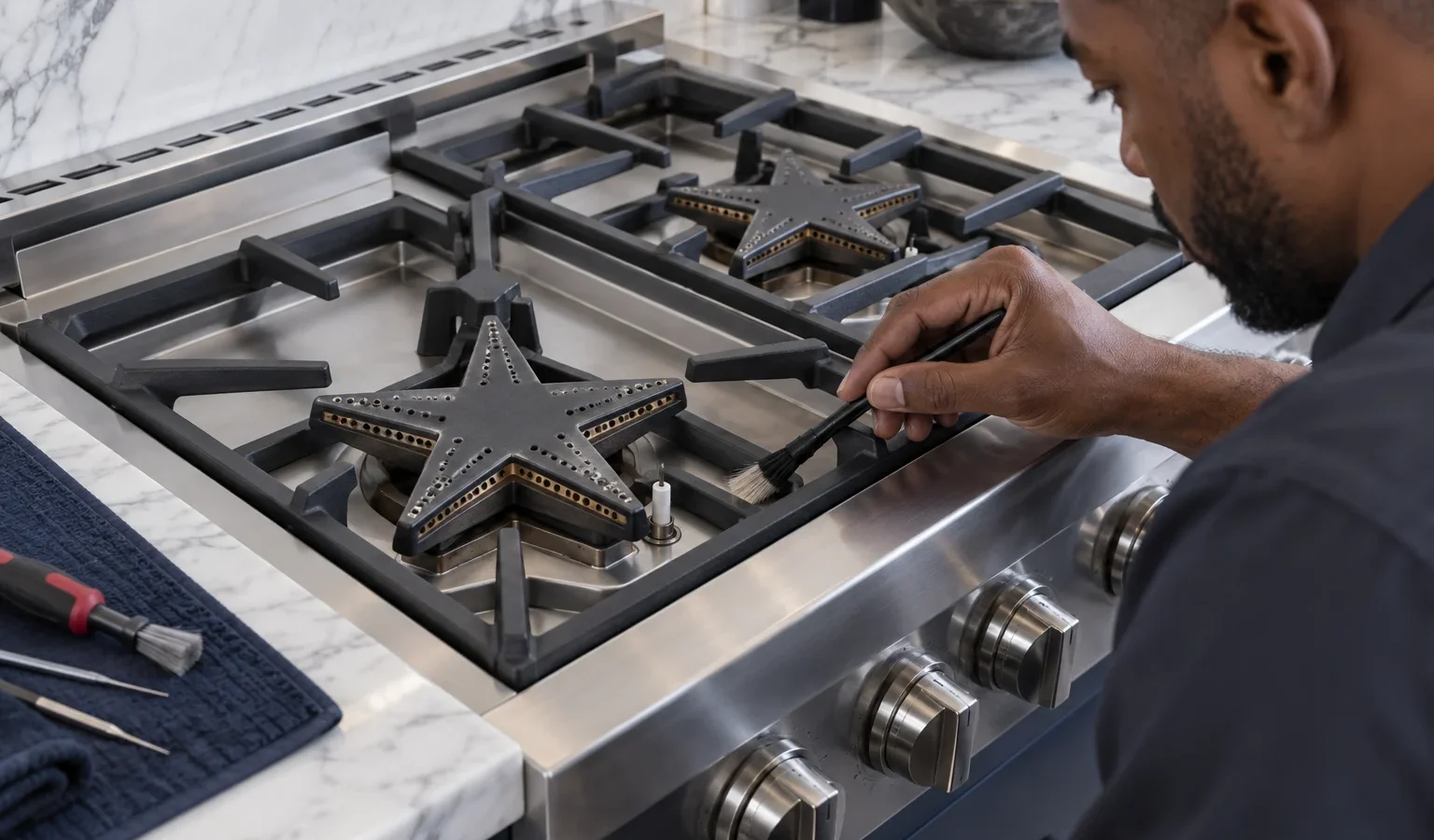
The spark is firing, so the electrical side is working. Now the question is gas and geometry. The burner cap may be sitting crooked or the wrong way around after cleaning. The ports, the tiny openings around the burner base, may be blocked by a boil-over, dried sauce or a grease film. The spark electrode may be coated and sparking weakly, or sparking at the wrong place. The gas valve behind the knob might not be opening. Only the last one needs a technician right away.
Many gas burners have a safety function that holds the flame signal only after the burner is hot enough to prove itself. If the flame goes out the moment you let go, the sensing part may be dirty or failing, or the flame may be too weak to register. Hold the knob in as the instructions describe, and note how long it takes for the issue to reappear.
A pattern like this is useful. If only the same burner fails every time, the cause is local to that burner: its cap, its ports, its electrode or its valve. If several burners next to each other fail together, a shared module or a wiring issue becomes more likely.
A professional-style Thermador range is heavy, set tight between cabinets, and often wired and plumbed behind a decorative surround. In Bay Area flats and older row houses, the gas line may have been extended during a remodel, and the range’s outlet may share a circuit that was never designed for a modern controller. A cleaning habit matters too: caps scrubbed with water and left damp, abrasive pads on electrodes, or spray cleaner pushed into the ports all appear in our visits.
That is why the model matters. A Thermador PRG486WDG is a gas range in the Pro Grand series, while a Thermador PRG486WDH is a Pro Harmony range. Both are listed in our Thermador range lineup, and the label tells us which service steps apply.
We confirm the supply is on and the gas odor test is clear. We then check the spark at each burner, the cleanliness of the electrode and its ceramic, the seat of the cap and head, the condition of the ports, and the response of the valve when the knob turns. If the display or the controller is involved, we look at the power arriving at the range and at the ignition module. If the oven side reports a fault, we read it and compare it with the entries in our error codes page.
Before any work begins you receive a written estimate, and nothing is repaired without your approval. If a gas component needs replacing, we explain which one and why, and we leave the burner tested and lit before we go.
Book a visit if more than one burner fails, if the clicking continues with no flame after the checks above, if the flame is uneven or yellow, if a burner lights and dies repeatedly, or if you notice a smell you cannot place. Our Thermador range repair page describes how a visit goes in San Francisco and the surrounding Bay Area. For a related symptom, Star burner keeps clicking covers what happens when the clicking never stops.
The spark is working, so the issue is usually gas reaching the flame. Common causes include a misaligned cap, blocked ports, a dirty electrode or a valve that is not opening. Clear visible debris and reseat the cap before booking.
We would rather you did not. If there is any smell of gas, do not light anything and leave the kitchen. A burner that works only with a match has a fault that needs a diagnosis.
The flame may be too weak to be detected, or the sensing part may be dirty or worn. Hold the knob as the instructions say, note whether it repeats, and book a visit if it does.
Yes. After an outage the range may need a controlled reset, and a surge can damage an ignition module. Reset once at the breaker and try again. If the problem remains, we check the power reaching the range.
The model number, which burners are affected, what you hear when you turn the knob, and any cleaning you did recently. Tell us if the gas supply was interrupted.
Share a few details and we’ll confirm an appointment. Prefer to talk? Call us and we’ll help right away.