
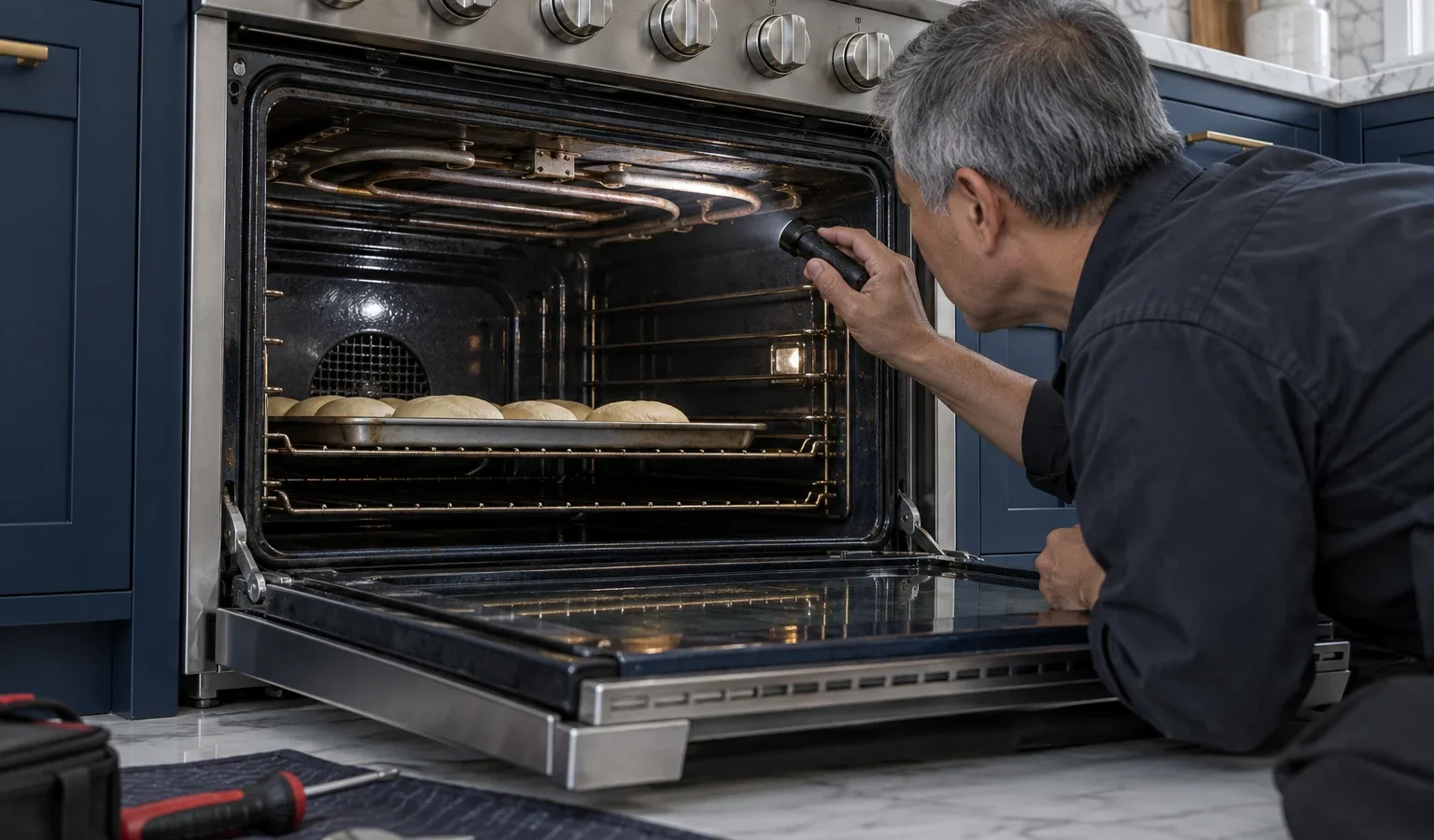

Specialized Thermador Appliance Repair in San Francisco
Mon–Sat: 8:00 AM – 7:00 PM
The oven in your Thermador range stays cold or barely warms. This article separates ignition, element, sensor and control problems and lists the checks that are safe.
Thermador repair · San Francisco & the Bay Area
When the oven side of a Thermador range stays cold, the cooktop above it often still works, which can mislead people into thinking the range is fine. The oven has its own heat source, its own temperature sensing and its own controls, and any of them can stop the cycle. How we approach the problem depends on whether the range is gas, dual-fuel or all-electric, so that is where to begin.
Thermador sells the same style of range in several configurations. Our listing includes the 48-inch Thermador PRD486WDGU, a dual-fuel range in the Pro Grand series, the gas PRG486WDG, also Pro Grand, and the PRG486WDH in the Pro Harmony series. Beyond those, the lineup includes ranges such as the MRI304DL and PRD304WHU. A gas oven lights a burner inside the cavity. A dual-fuel range uses gas on the cooktop and an electric oven. Knowing which you have narrows the list of suspects immediately.
A gas oven needs an igniter that glows, a valve that opens in response, and a flame that burns steadily. The common failure is a weakened igniter. It can still glow, which looks fine, but it no longer draws enough current to open the valve. The oven then clicks, ticks or hums, and never lights. A blocked burner, a closed gas valve to the range or a tripped breaker that powers the controller can have the same effect. If you smell gas, do not operate the oven. Leave and call the gas utility or 911 from outside.
An electric oven relies on bake and broil elements, relays that switch them, and a sensor that reports the cavity temperature. If the oven lights up but never rises, an element may have failed. If the display runs normally and no heat appears at all, a relay on the control, a thermal limit or the sensor circuit are more likely. Some failures only affect one mode, such as bake working while broil does not, which is a good clue to give us on the phone.
The control watches a temperature sensor. If the reading is missing or absurd, it ends the cycle for safety. We cover several of these:
On 48-inch ranges a few faults, such as E12 for a missing expansion board, switch off the second oven or both ovens. Read the full page for the code you see, because the meaning also tells you whether the oven can be used at all. A display that is blank or flashes without any code may point to power instead.
Do not light a gas oven manually with a match. Do not open any rear or lower panel. Do not test elements or the igniter with a meter. Do not switch the range back on repeatedly with the door open to see whether the element glows. And do not start a cleaning cycle while a code is showing.
Large Thermador ranges sit in deep cabinetry and are often connected through a long gas hose or a heavy-duty cord. They are heavy. Moving one safely is a two-person job at least, and we only do it when it is needed. A range recessed into custom surrounds or stone may leave little room to reach the back, so we plan the visit for the access. In older flats, wiring that was extended for a remodel can show up as a supply fault rather than an appliance fault, which is why a voltage-related code needs a careful look and not an immediate part change.
We diagnose first. That means reading the code history, checking the supply, testing the igniter or elements, verifying the sensor and looking at the control. You receive a written estimate before we replace anything, and we only proceed with your approval. The model number helps, and our short guide to finding your Thermador model number shows where it is usually printed. Visit the Thermador range repair page for how we cover San Francisco and the Bay Area, and the range lineup guide for the families we service. If your oven is a separate wall unit instead, oven not heating is the matching article.
On a gas oven, the igniter can glow but be too weak to open the gas valve. On an electric oven, a failed element or a relay that does not close can leave the cavity cold while the display looks normal.
It is a frequent cause of heating problems, and it often produces an E3 or E4 style message. The control cuts off the oven when it cannot trust the reading.
No. The cooktop and oven have separate heat sources and controls. A fault in the oven control or sensor will not affect the burners above.
It depends on the code. Some stop only the affected oven, others stop both on larger ranges. Read the code page, and if the oven will not heat, do not keep forcing it.
That tells us a lot. It usually points to one element or one relay, not the whole oven. Tell us which mode works when you request a visit.
Share a few details and we’ll confirm an appointment. Prefer to talk? Call us and we’ll help right away.