

Specialized Thermador Appliance Repair in San Francisco
Mon–Sat: 8:00 AM – 7:00 PM
A Star burner that clicks long after it should have lit, or clicks by itself, is signalling moisture, dirt or an igniter fault. Here is what to look at first.
Thermador repair · San Francisco & the Bay Area
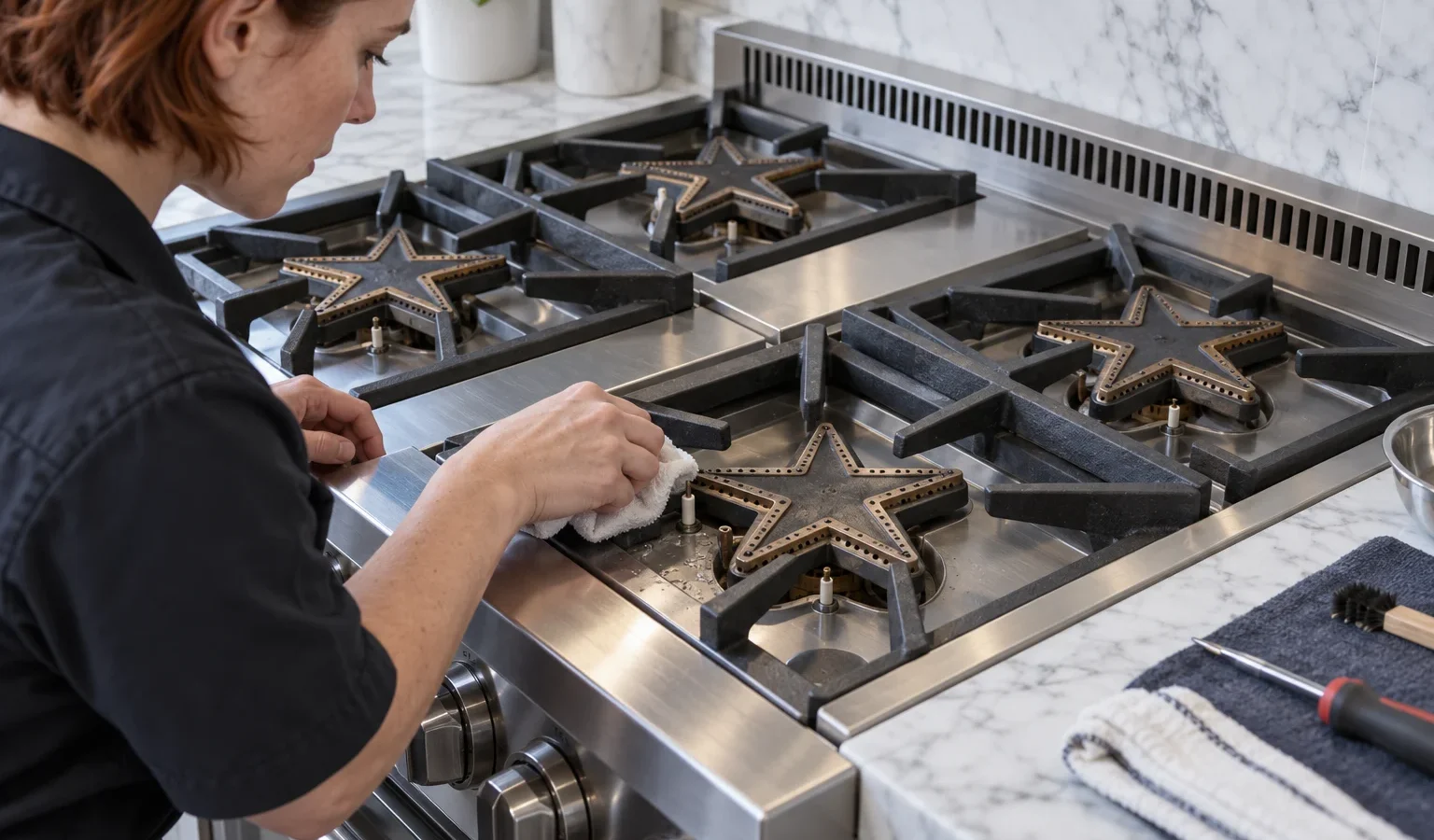
The ticking of an igniter is meant to be brief. When it carries on, it becomes a nuisance and, more importantly, a clue. On a Thermador gas cooktop, rangetop or range with Star burners, the cap and base sit close to the spark electrode. That close fit is why a clean, dry burner matters so much, and why small amounts of moisture or residue can keep it clicking.
Describe the sound to yourself in terms of when it happens, because each timing points to a different fault.
This is the classic one, and it overlaps with the situation in our guide on a range burner that will not light. The usual suspects are a cap sitting off-center, port openings clogged with food, or an electrode that is too dirty to produce a good spark at the right place.
Once a flame is established, the clicking should stop. If it continues, the control is not receiving the signal that tells it the flame is present. That can be due to a dirty electrode, a flame that is lifting or sitting unevenly, moisture on the ignition parts, or a switch circuit that is confused. Watching the flame helps: if it looks steady and blue and the clicking still continues, the sensing side is the first place to look.
Random ticking, especially after cleaning or in humid weather, often means that a spark switch behind a knob is sticking, that liquid has reached a switch contact, or that the module is being triggered falsely. This one deserves attention, because an unwanted spark near a gas burner is something to resolve promptly. If a gas smell accompanies it, leave the house and call the gas utility or 911 from outside. If you notice burning, a hot smell or sparks anywhere other than at the burner, turn the power off at the breaker.
If the clicking stops after drying, you found the cause. Keep spray cleaners away from the knob area in the future.
Do not remove knobs, the cooktop surface or any panel. Do not touch the electrode with a metal tool, and do not use a wet cloth on it while the range is powered. Do not tape or hold down a switch. Do not disconnect the gas or loosen any fitting to see whether the sound stops. These steps do not fix the cause, and some of them create a hazard.
Thermador gas surfaces are often installed flush in stone counters, and rangetops sit between cabinets with a limited gap on each side. Spills run into those gaps and wick under the control area. Ranges with a back guard or a griddle section add more places for grease to collect. A kitchen with an island hood nearby may also have strong air movement across the burners, which affects how a flame behaves and how the sensing responds. On installations where a cooktop feeds from a shared ignition module, one wet burner can make all of them tick.
Knowing the exact unit matters. The Thermador SGS305TS and SGS365TS are listed as gas cooktops, and the PCG305W as a rangetop. The Thermador range guide covers ranges with the same burners. Gas ranges fall under our range repair work, while cooktops and rangetops are covered by Thermador cooktop repair. Check the cooktop and rangetop guide to see where the model label is usually found, typically on the side of the chassis or under the surface.
We start by confirming it is safe: no gas odor, power as expected, controls in the off position. Then we test the spark at each burner, inspect the electrode and its insulator, check the seat of the cap and head, test the knob switches and look at the ignition module. If the cause turns out to be moisture, we explain how to prevent a repeat. If a part has failed, you receive a written estimate and we change nothing until you approve it.
Book if the clicking continues after everything is dry and reseated, if it begins on its own, if multiple burners click at once, or if a burner will not stay lit. If the clicking is paired with a flame that looks wrong, stop using that burner until it is checked.
The control is not recognizing that a flame is present. A dirty electrode, moisture on the ignition parts, a cap that is not seated or a flame that sits unevenly can all cause this. Dry and reseat the parts first.
Several burners often share one ignition module. Moisture at a single switch or electrode can trigger the module, and every spark circuit then ticks together.
The spark itself is not the main hazard. Unwanted sparking near a burner, though, means the ignition circuit is not behaving. Turn the knobs fully off, and if you smell gas, leave and call the gas utility or 911 from outside.
Wait until the cooktop is cool and the power is off at the breaker, and use only a barely damp cloth around the visible tip. Avoid sprays and never push tools into the burner base.
Only briefly. If the sparks go on well beyond the moment the flame appears, or the burner keeps clicking after it is lit, the sensing or the ignition parts need to be checked.
Share a few details and we’ll confirm an appointment. Prefer to talk? Call us and we’ll help right away.