

Specialized Thermador Appliance Repair in San Francisco
Mon–Sat: 8:00 AM – 7:00 PM
A water tank message on a Thermador steam oven usually points to the tank, the fill path or the steam generator. Here is how to sort it out before you book a visit.
Thermador repair · San Francisco & the Bay Area
A steam oven cooks with water, so every one of its water messages is really a question about one thing: is water getting from where it is stored to where it becomes steam? When a Thermador steam or combi-steam oven shows a water tank warning, the display is telling you that something in that chain is not behaving as the control expects. It might be as small as a tank that is not fully seated. It might also be a sensor, a pump or a scaled-up steam generator that needs a technician.
Most water warnings fall into three families. The first is “the oven thinks the tank is empty.” The second is “the oven cannot find the tank at all.” The third is “water is present, but it is not moving the way the control expects.” Each family points toward a different part of the system, which is why the exact wording on the display and the moment it appears matter so much.
Whether your oven uses a removable tank at the front or a plumbed supply depends on the installation, and we confirm that from the model label instead of guessing. The combi/steam models we list on this site, such as the Thermador MEDS301BS and the Thermador PODS301B, are examples of units where the question comes up often, but the same logic applies across the whole Thermador steam oven lineup.
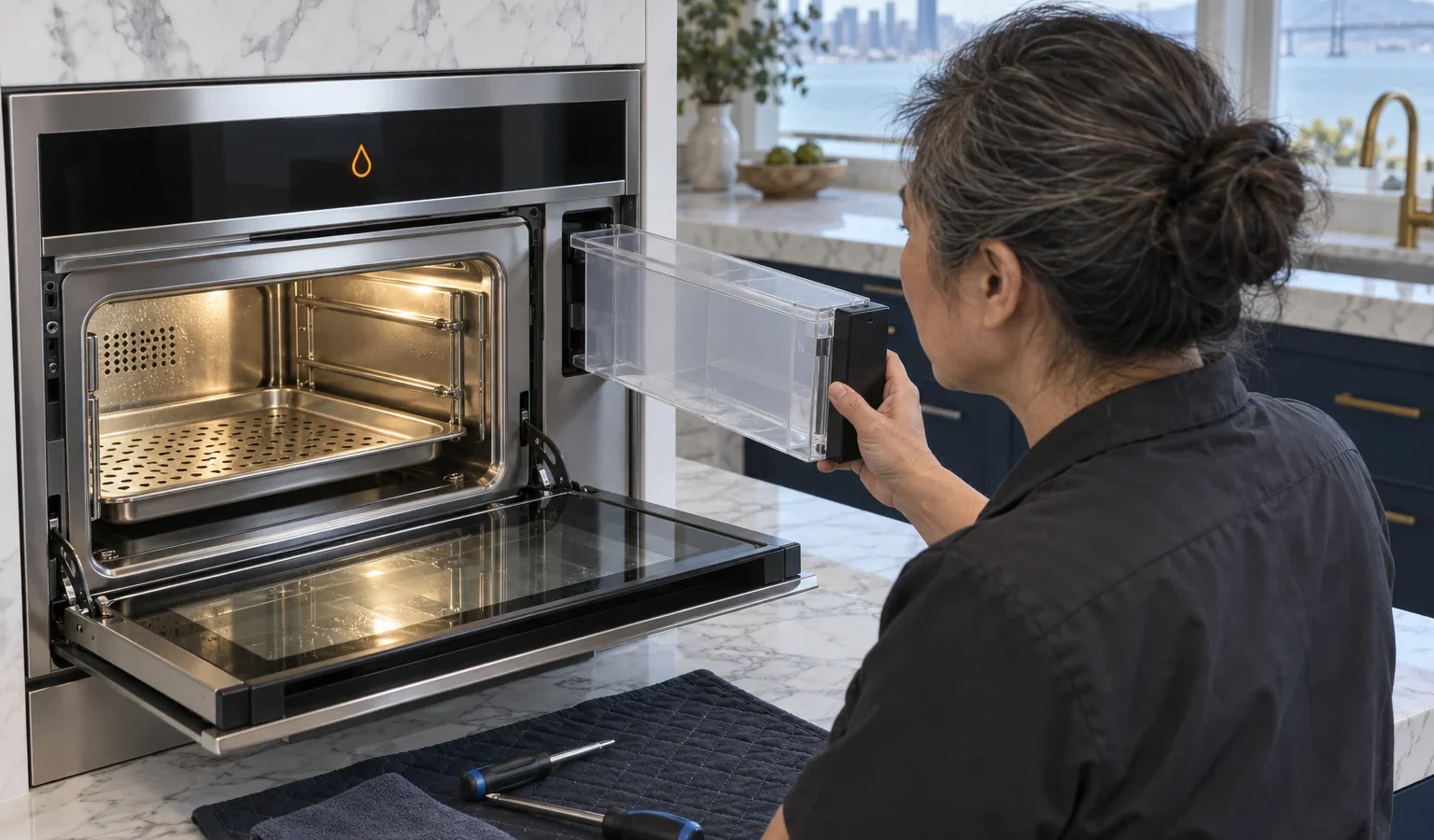
A tank that sits slightly off its connector can look perfectly normal from the front. The oven then reads it as missing or empty. A cracked cap, a worn seal or a small piece of debris on the connector face produces the same result. This is the most common cause, and it is also the cheapest to rule out.
Steam equipment concentrates whatever minerals it is given. Over time a chalky film builds on the level sensor, in the small passages and inside the steam generator. A sensor coated with scale reports the wrong level. A narrowed passage slows the flow so the oven concludes the water never arrived.
The level sensor and the tank-present switch are simple devices, but they live in a wet environment. Moisture in a connector, a corroded contact or a failed sensor produces warnings that appear and disappear with no pattern.
Between the tank and the steam generator sits a pump, or on a plumbed unit an inlet valve. When that component weakens, you may hear the oven try to fill and then give up, or hear nothing at all.
If the tank, sensor and pump all check out, attention moves to the steam generator itself. Scale can insulate its heating surface or choke its outlet, and the control reacts by flagging a water problem. This is not an owner repair, and it should not be forced by running the oven repeatedly.
If the warning returns the same way, stop retrying. Repeated fill attempts on a weak pump or a scaled generator only add wear.
If you see water pooling under the oven, smell something burning or notice the lights flicker, switch the oven off at the breaker and leave it off until it has been inspected.
Steam ovens in San Francisco kitchens are often built into tall cabinet runs or sit above another oven, which leaves very little room to see the water connections. A unit set flush with panel-ready cabinetry can hide a drip for a long time. On plumbed units, the supply line and its shut-off are part of the diagnosis as much as the oven itself. We look at how the oven is fitted before we test parts, because a pinched line changes what the symptoms mean.
We diagnose the oven before any repair is proposed. That means confirming the model number, reading the stored message, checking the tank or supply path, and testing the level sensing and the pump or valve in a controlled order. You then get a written estimate describing what we found and what we recommend, and nothing is repaired until you approve it.
Having the model number ready helps. On a steam oven it is usually on the oven frame or inside the door edge, and our guide on how to find your Thermador model number shows the usual places.
Our Thermador steam oven repair page explains how we handle these ovens across San Francisco and the Bay Area. If your oven is only one part of a double stack, you may also be dealing with a conventional oven nearby, in which case oven not heating covers the other side of the cabinet.
The oven usually has not registered the tank. A tank that is slightly misaligned, a dirty connector face or a level sensor coated with scale can all make a full tank read as empty. Reseat the tank firmly first. If the message returns, the sensing or the fill path needs a technician.
Yes. Minerals build up on sensors, in narrow passages and inside the steam generator, and they can slow the fill or distort the level reading. Following the cleaning routine in the use-and-care guide helps, but heavy buildup inside the oven is a service matter.
It is better not to. Running a steam cycle with an unreliable water supply can stress the pump and the steam generator. Use another oven for now and have the warning looked at.
If the oven has a plumbed supply and you see a leak at the supply line or its valve, a plumber may be needed for that line. If the message appears with no visible leak, the problem is inside the oven and an appliance technician is the right call.
Give us the model number, the exact message, when it appears in the cycle and whether the oven uses a removable tank or a plumbed supply. Mention anything you already tried, such as reseating the tank or a power reset.
Share a few details and we’ll confirm an appointment. Prefer to talk? Call us and we’ll help right away.