
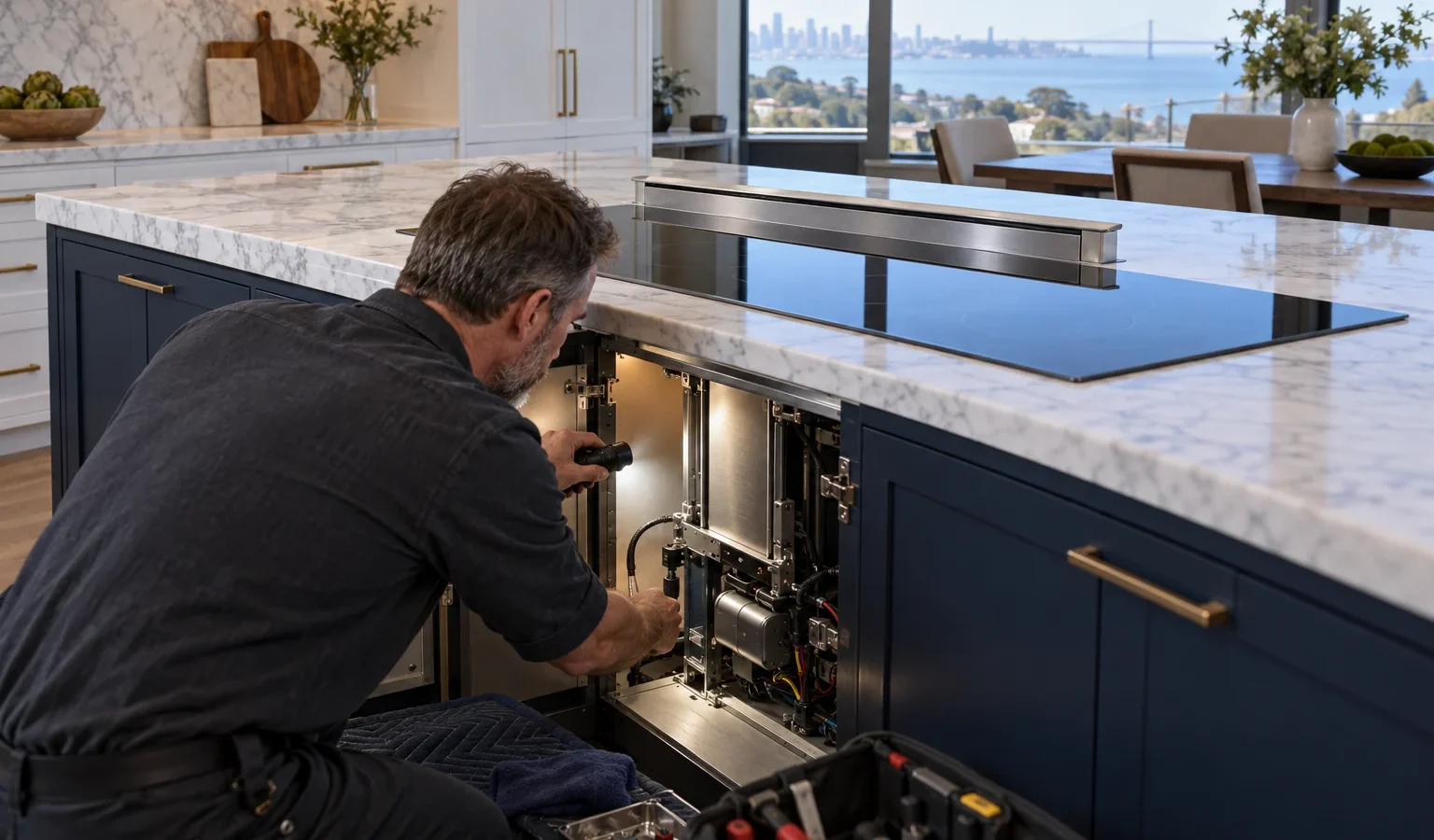

Specialized Thermador Appliance Repair in San Francisco
Mon–Sat: 8:00 AM – 7:00 PM
The downdraft vent beside the cooktop sits flat while you cook. Learn why a stuck lift happens, what to check from the countertop and when the mechanism needs a technician.
Thermador repair · San Francisco & the Bay Area
A downdraft vent is a bit of kitchen theater: you press a button and the vent slides up from behind the cooktop to catch steam and smoke at the source. When it refuses to rise, the whole idea of a clean, uncluttered countertop falls apart, because without the vent you are cooking with no ventilation at all. The mechanism combines motors, tracks, switches and a blower, and any part of that chain can fail.
Press the control and listen. If nothing sounds, the lift is probably not receiving the command. If you hear the lift motor straining, grinding or clicking but the vent hardly moves, something is jammed or the drive is worn. If the vent rises partway and stops, an obstruction or a position sensor may be involved. If the vent rises but the blower does not start, the lift is fine and your issue belongs with the blower or its control. These differences decide where the diagnosis starts.
It also helps to note when the problem began. A downdraft that stopped working right after a deep clean is a very different case from one that has become slower over months. A vent that rises but sticks on the way down after cooking points toward friction or grease on the track.
Do not pull on the vent or force it up by hand. A lift motor under load is easily stripped, and a bent track makes the repair longer. Do not pour degreaser into the slot or spray cleaner on the vent grille; liquid that runs down reaches the motor and wiring. Do not remove the cooktop to look underneath. And do not cook on high heat without ventilation while the vent is stuck down: open a window, and keep the heat low or move to another burner arrangement until it is fixed. If you notice a burning smell from beneath the cooktop, shut off the breaker and stay clear.
A downdraft sits in a cutout in the countertop, and the blower is typically mounted in the cabinet below, with the ductwork leaving the space through a wall or the floor. Cabinet drawers directly under the vent can restrict access, and the clearance in a tight kitchen decides how easily a technician can see the lift. In Bay Area homes with crawl spaces or narrow kitchens in flats, the duct run may be long, and the exhaust path is a part of the diagnosis. A vent that rises but pulls poorly may have a duct issue rather than a lift issue.
We watch the lift in action, check the controls, and look at the track, motor and position switches. We also examine the blower and its connections, since a downdraft that rises but does not extract is a separate fault. You get a written estimate before work begins, and nothing is repaired without your approval.
Your model number is usually on the cooktop’s chassis, or on a label visible when the vent is accessed from the cabinet below. We see downdrafts such as the UCVM30XS and UCVM36XS.
Book when the vent does not move, moves only partway, makes grinding or clicking sounds, or rises but does not draw air. Plan a visit before the next heavy cooking week if you rely on the downdraft to keep the kitchen clear. See our Thermador range hood repair page for how ventilation visits run, and the Thermador range hoods overview for the lineup.
Grease on the track or a tiring motor are the common reasons. Gentle cleaning of reachable surfaces helps only if the cause is residue.
Light cooking with a window open is manageable. Avoid heavy frying and searing until it works again.
Yes. Liquid and crumbs form a sticky layer that traps small objects and jams the sliding parts.
That points to the blower or the ducting, not the lift. Mention it clearly when you book.
Not always. The answer depends on what has failed and how the unit is installed, and we explain it in the estimate.
Share a few details and we’ll confirm an appointment. Prefer to talk? Call us and we’ll help right away.